Vyjayanthimala: Biography, Facts and Career
Who is Vyjayanthimala? An evergreen, sourced profile: biography, key facts and career.
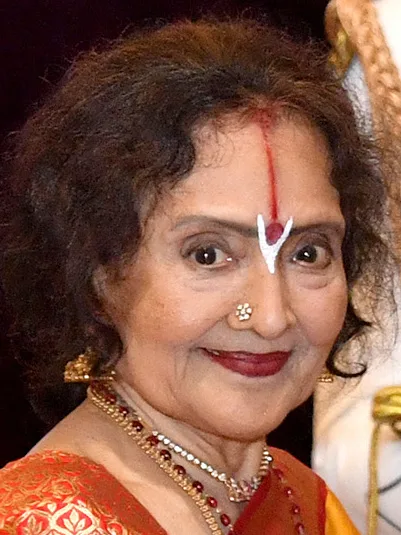
Vyjayanthimala Bali (née Raman; born 13 August 1933), known mononymously as Vyjayanthimala, is an Indian parliamentarian, dancer and former actress. Considered the first female superstar of Indian Cinema, she successfully transitioned from a child actor to one of the highest-paid and leading actresses of the 1950s and 1960s. Her performances were noted for integrating Indian classical dance with dramatic acting, helping her establish herself as one of Hindi cinema's finest actresses and dancers. In addition to several accolades, including four Filmfare Awards and two BFJA Awards, she was awarded the Padma Shri from the Government of India in 1968 and later Padma Vibhushan in 2024. She made her screen debut at the age of 16 with the Tamil film Vaazhkai (1949), and followed this with a role in the Telugu film Jeevitham (1950). Her first work in Hindi cinema was the social guidance film Bahar (1951), which she headlined, and achieved her breakthrough with the romance Nagin (1954). She garnered widespread critical acclaim for her role in the period drama Devdas (1955), where she played Chandramukhi, a tawaif with a heart of gold. The film and her acting were highly praised, later considered to be her magnum opus. For Devdas, she won the Filmfare Award for Best Supporting Actress which she refused, stating that she played a leading role equal to that of Suchitra Sen, her co-star, and so she could not accept the award for a supporting role. She went on to star in series of commercial successes, which include the romance New Delhi (1956), the social drama Naya Daur (1957) and the comedy Aasha (1957). Her roles in the social drama Sadhna (1958) and the paranormal romance Madhumati (1958), each earned her a nomination for the Filmfare Awards for Best Actress, winning for the former which makes her the first ever actor to receive dual nominations in an acting category in the same year. The nominations also makes her the first-ever multi-nominee across all categories. This win makes her the first performer in Filmfare history to win in both leading and supporting categories. In the 1960s, the crime drama Gunga Jumna (1961) saw Vyjayanthimala playing a rustic village belle, Dhanno, a role which won her the Filmfare Award for Best Actress. She won the award again for the musical romantic drama Sangam (1964). She went on reinvent her image, earning a mixed reception after notably appearing in a one-piece swimsuit in a film role. She later achieved acclaim for her performance in the historical drama Amrapali (1966) which was based on the life of Nagarvadhu, royal courtesan of Vaishali, Amrapali. Her notable successes following were the swashbuckler film Suraj (1966), the heist film Jewel Thief (1967), the Bengali art film Hatey Bazarey (1967), the action drama film Sunghursh (1968) and the epic film Prince (1969). In 1968, she was awarded the Padma Shri by the Government of India, the fourth-highest civilian honor. After a starring role in the film Ganwaar (1970), Vyjayanthimala retired from the acting industry. She has since gained popularity for her dancing, particularly for her work in Bharata Natyam, a form of Indian classical dance, and was later given the Sangeet Natak Akademi Award, the highest Indian recognition given to practising artists. In 2024, she was awarded the Padma Vibhushan, the second-highest civilian honor granted by the Government of India.
Quick facts about Vyjayanthimala
- Full name: Vyjayanthimala
- Born: 1936-08-13
- Nationality: India
- Known as: Actor
- Wikidata ID: Q467977
Profile compiled from public Wikipedia and Wikidata data. Details can change over time.
Frequently asked questions
Who is Vyjayanthimala?
Vyjayanthimala Bali (née Raman; born 13 August 1933), known mononymously as Vyjayanthimala, is an Indian parliamentarian, dancer and former actress.
What nationality is Vyjayanthimala?
Vyjayanthimala is India.
When was Vyjayanthimala born?
Vyjayanthimala was born on 1936-08-13.
Sources
More in Celebrities
Keep reading