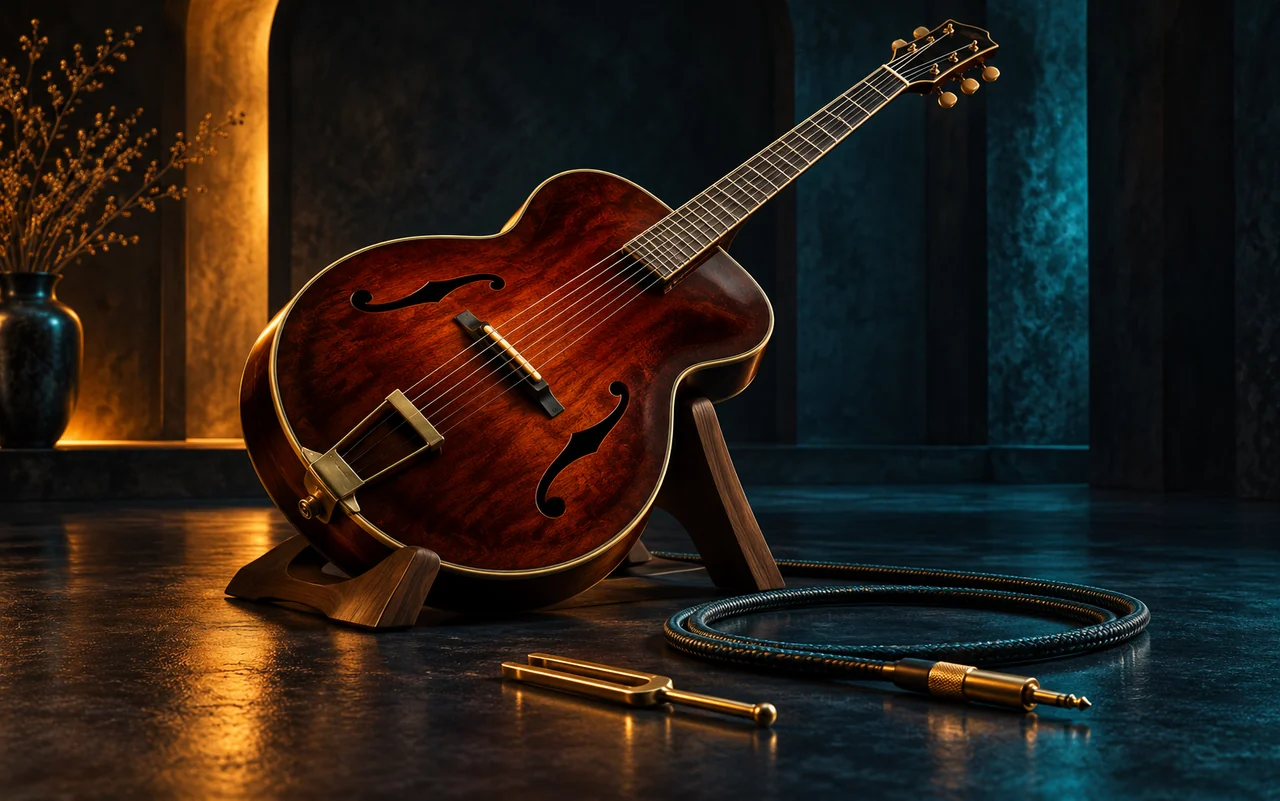
Stromberg Guitar, used by Irving Ashby: Museum Object and Cultural History
Stromberg Guitar, used by Irving Ashby: date made: 1939 - 1941. user: Ashby, Irving. maker: Charles A. Stromberg and Son.
The object in the museum catalogue
This guitar was made by Charles A. Stromberg and Son of Boston, Massachusetts around 1939-1941. Responding to requests from jazz guitarist for an instrument that could cut through and be heard over the horn section of jazz bands, Elmer Stromberg developed his giant, 19-inch wide Master 400 model. It is one of the loudest acoustic guitars ever made. Elmer Stromberg made about 600 guitars with his father, Charles, a Swedish immigrant.
Charles and Elmer Stromberg’s shop was a popular hang-out for local guitarists who would break in new instruments before they were sold to customers. One such local was Irving Ashby, a Boston native who went on to play with the Lionel Hampton Orchestra and the Nat King Cole Trio. This six course (6x1) guitar, Master 400 model, and serial #507, was custom made for American jazz guitarist, Irving Ashby (1920-1987).
Materials, dates and provenance
- date made: 1939 - 1941
- user: Ashby, Irving
- maker: Charles A. Stromberg and Son
- Object Name: guitar
- Measurements: overall: 43 1/4 in x 19 in x 4 1/2 in; 109.855 cm x 48.26 cm x 11.43 cm
- place made: United States: Massachusetts, Boston
- ID Number: 1988.0421.01
- accession number: 1988.0421
- catalog number: 1988.0421.01
- Credit Line: Gift of Pauline Randolph Ashby
- Data Source: National Museum of American History
Sources and reuse
Catalogue descriptions and facts adapted from National Museum of American History through the Smithsonian's official Open Access dataset. This record explicitly marks its metadata CC0 1.0; formatting and selection have been changed.
Sources
More in Music
Keep reading