Bon chic bon genre: History and Key Facts
Bon chic, bon genre (French for 'good style, good class'; IPA: [bɔ̃ ʃik bɔ̃ ʒɑ̃ʁ]) is an expression used in France to refer to a subculture of stylish members of the Parisian upper class.
Oldest entries first, in a fixed order. Newly added articles appear at the end. Explore a shuffled selection →
Bon chic, bon genre (French for 'good style, good class'; IPA: [bɔ̃ ʃik bɔ̃ ʒɑ̃ʁ]) is an expression used in France to refer to a subculture of stylish members of the Parisian upper class.
Marcelle Chaumont (born 1891, Eymoutiers, Haute-Vienne; died 1990, Paris) was a French fashion designer.

Clarins is a French global leader in luxury skincare and cosmetics, renowned for its pioneering fusion of science and nature.

In fashion design, "boyfriend" is a style of women's clothing that draws heavily from corresponding men's garments.

Louise Chéruit (née Lemaire; 1866–1955), also known as Madame Chéruit and often erroneously called Madeleine Chéruit, was a French fashion designer.
Cosmetics, first used in ancient Rome for ritual purposes, were part of daily life.
Camp is an aesthetic and sensibility that regards something as appealing or amusing because of its heightened level of artifice, affectation, and exaggeration, especially when there is also a pla
Business casual is an ambiguously defined Western dress code that is a form of smart casual wear for business purposes, replacing traditional business wear ("informal wear") for white-collar work

Marie-Françoise Corot (1768–1851) was a French fashion designer (milliner), known as one of the most fashionable of her trade in the first decades of the 19th-century.
The oyster dress is a high fashion gown created by British fashion designer Alexander McQueen for his Spring/Summer 2003 collection Irere.
A capsule wardrobe is a minimalist collection of clothes that can be put together in different ways to cover a variety of outfits and occasions.

Chinoiserie in fashion refers to the any use of chinoiserie elements in fashion, especially in American and European fashion.
The TechHaus Volantis is an American electric-powered hover vehicle commissioned by American singer Lady Gaga as a "flying dress" in support of her 2013 album Artpop.
Communist chic are elements of popular culture such as fashion and commodities based on communist symbols and other things associated with Marxism, Leninism, socialism and communism.
Face powder is a cosmetic product applied to the face to serve different functions, typically to beautify the face.
Cottagecore is an internet aesthetic and subculture centred on rural way of life.
The hypothesis of female cosmetic coalitions (FCC) represents a controversial attempt to explain the evolutionary emergence of art, ritual and symbolic culture in Homo sapiens.
Outfit matching or couple costume/look are Chinglish and Konglish terms, respectively, for the practice of a couple wearing the same clothing in public to signal their relationship.
Mohamed Dia (born 5 August 1973 in the Sarcelles) is a Franco-Malian designer of sport clothing (sportswear and streetwear) and founder of the M.Dia brand.

Empire silhouette, Empire line, Empire waist or just Empire is a style in clothing in which the dress has a fitted bodice ending just below the bust, giving a high-waisted appearance, and a gathe
E-girls and e-boys, sometimes collectively referred to as e-kids, are a youth subculture that emerged in the late 2010s, notably popularized by the video-sharing application TikTok.
Hard Candy is an American cosmetics company, founded in 1995 by Iranian-American sisters Dineh Mohajer and Pooneh Mohajer (who now owns tokidoki), along with Dineh's ex-boyfriend Ben Einstein (wh

Benoît-Pierre Emery (pronounced [bənwa pjɛʁ ɛm(ə)ʁi]; born 9 July 1970) is a French art director and a fashion designer based in Paris, France.
Adélaïde Henriette Damoville (Madame Eloffe; 1759–1805) was a French fashion merchant.
Fashion is a term used interchangeably to describe the creation of clothing, footwear, accessories, cosmetics, and jewellery of different cultural aesthetics and their mix and match into outfits
Huadian (traditional Chinese: 花鈿; simplified Chinese: 花钿), also known as huazi (Chinese: 花子; lit.
Mademoiselle Félicie (19th-century) was a French fashion designer milliner.
Cosmetics ingredients come from a variety of sources but, unlike the ingredients of food, are often not considered by most consumers.
Fuyao (Chinese: 福耀; pinyin: fúyào), sometimes translated as Fortune and prosperity in English, is an ancient Chinese concept with a negative connotation which was employed to refer to any garment
Institut Jeanne Gatineau was a French cosmetics business which emphasized products for the face and body.
A geek is slang originally for an eccentric, awkward, non-mainstream person and, in its current use, more narrowly such a person who is obsessed with a particular hobby or intellectual pursuit.
Maud Frizon de Marco (born Danielle Maud Frizon; 1941 in Paris, France) is a fashion designer specializing in women's shoes.
Jean Paul Gaultier (French: [ʒɑ̃ pɔl ɡotje]; born 24 June 1952) is a French haute couture and prêt-à-porter fashion designer.
Lady Esther was the trademark of a cosmetic manufacturing company founded by German-born Syma Cohen and her siblings in Chicago in 1913 and operated as Lady Esther Company.
Gyaru (Japanese: ギャル, pronounced [ɡʲaꜜɾɯ]) is a Japanese fashion subculture for all ages, often associated with gaudy fashion styles, an extreme makeup style and dyed hair.
Madame Grès (1903–1993), also known as Alix Grès and Alix, was a leading French couturier and costume designer, founder of haute couture fashion house Grès as well as the associated Parfums Grès.

The terms hipster or hepcat, as used in the 1940s, referred to aficionados of jump blues and jazz, in particular bebop, which became popular in the early 1940s and later into the 1950s being asso
Jacques Guarrigue-Lefèvre is the founder, owner and current president of Paris Élysée, a private club based in Paris.
The 21st-century hipster is a subculture (sometimes called hipsterism) typically associated with urban millennials.
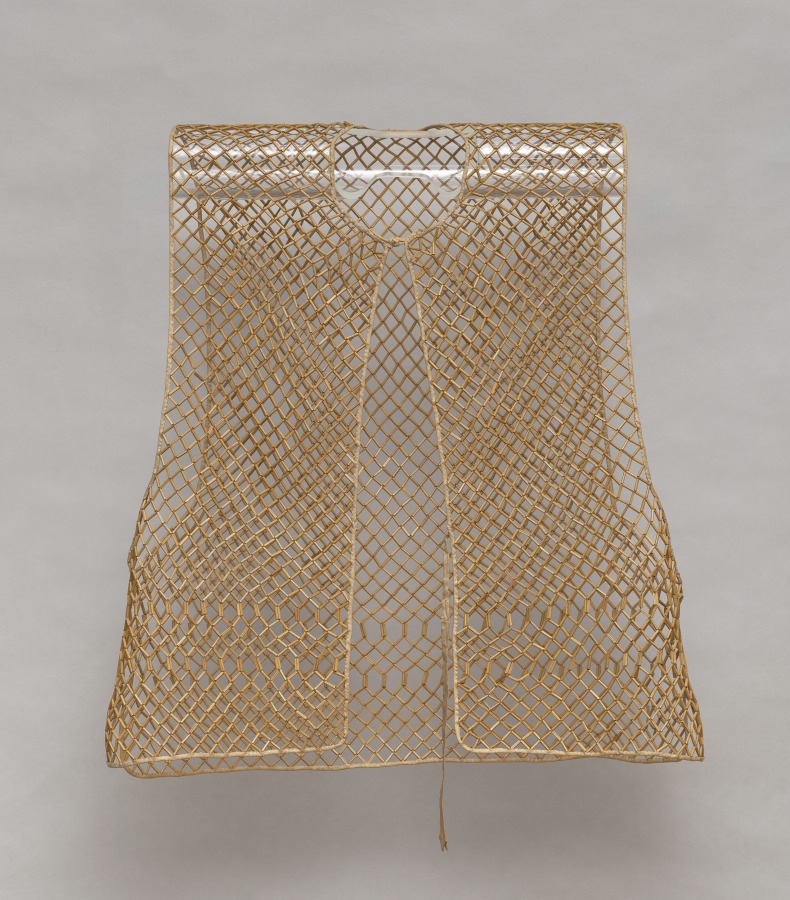
Sleeveless garment at the Cleveland Museum of Art: 1800s, Bamboo beads strung together in diamond and hexagon patterns; edges in plain weave cotton. Explore the work's context, creator attribution and collection history.