Athanasius Kircher: Biography, Facts and Career
Who is Athanasius Kircher? An evergreen, sourced profile: biography, key facts and career.
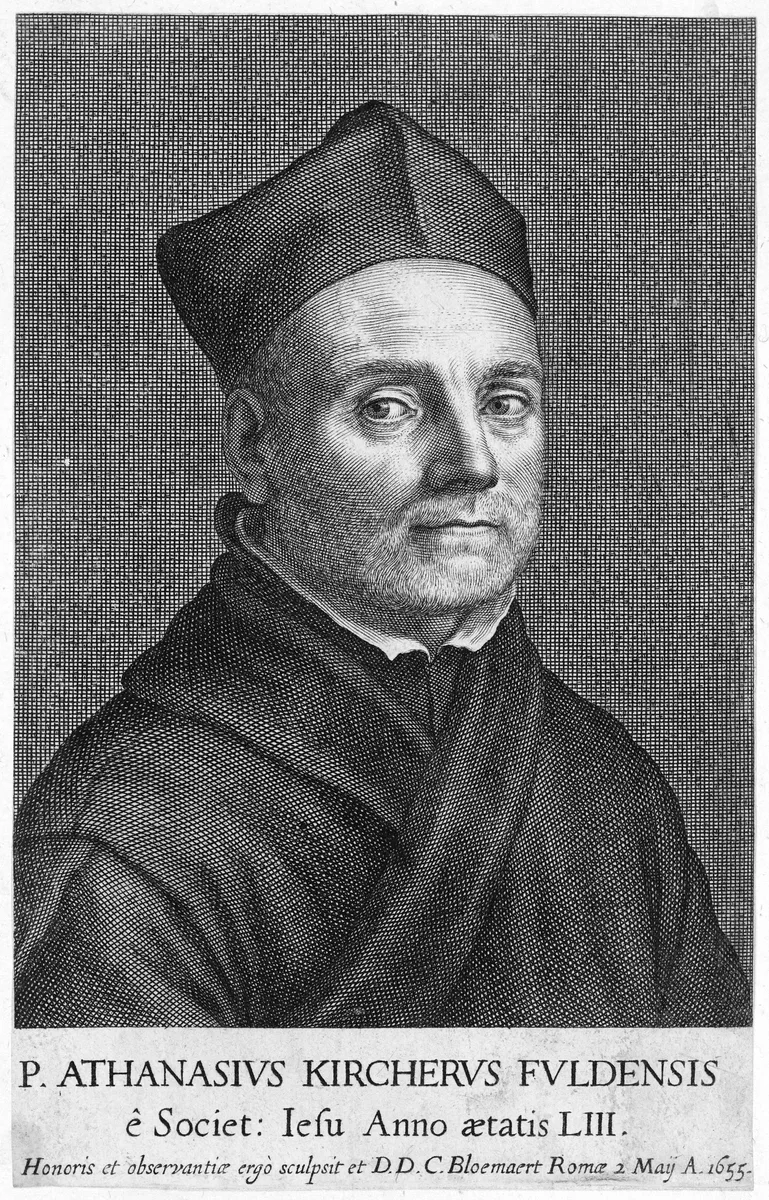
Athanasius Kircher (2 May 1601/1602 – 27 November 1680) was a German Jesuit scholar and polymath who published around 40 major works of comparative religion, geology, and medicine. Kircher has been compared to fellow Jesuit Roger Joseph Boscovich and to Leonardo da Vinci for his vast range of interests, and has been honoured with the title "Master of a Hundred Arts". He taught for more than 40 years at the Roman College, where he set up a wunderkammer or cabinet of curiosities that would become the Kircherian Museum. A resurgence of interest in Kircher has occurred within the scholarly community in recent decades. Kircher claimed to have deciphered the hieroglyphic writing of the ancient Egyptian language, but most of his assumptions and translations in the field turned out to be wrong. He did, however, correctly establish the link between the ancient Egyptian and the Coptic languages, and some commentators regard him as the founder of Egyptology. Kircher was also fascinated with Sinology and wrote an encyclopedia of China, where he revealed the early presence of Nestorian Christians while also attempting to establish links with Egypt and Christianity. Kircher's work in geology included studies of volcanoes and fossils. One of the first researchers to observe microbes through a microscope, Kircher was ahead of his time in proposing that the plague was caused by an infectious microorganism and in suggesting effective measures to prevent its spread. Kircher also displayed a keen interest in technology and mechanical inventions; inventions attributed to him include a magnetic clock, various automatons and the first megaphone. The invention of the magic lantern has been misattributed to Kircher, although he conducted a study of the principles involved in his Ars Magna Lucis et Umbrae. A scientific star in his day, towards the end of his life he was eclipsed by the rationalism of René Descartes and others. In the late 20th century, however, the aesthetic qualities of his work again began to be appreciated. One modern scholar, Alan Cutler, described Kircher as "a giant among seventeenth-century scholars", and "one of the last thinkers who could rightfully claim all knowledge as his domain". Another scholar, Edward W. Schmidt, referred to Kircher as "the last Renaissance man". In A Man of Misconceptions, his 2012 book about Kircher, John Glassie wrote "many of Kircher's actual ideas today seem wildly off-base, if not simply bizarre," but he was "a champion of wonder, a man of awe-inspiring erudition and inventiveness," whose work was read "by the smartest minds of the time."
Quick facts about Athanasius Kircher
- Full name: Athanasius Kircher
- Born: 1602-05-02
- Nationality: Holy Roman Empire
- Known as: Author
- Wikidata ID: Q76738
Profile compiled from public Wikipedia and Wikidata data. Details can change over time.
Frequently asked questions
Who is Athanasius Kircher?
Athanasius Kircher (2 May 1601/1602 – 27 November 1680) was a German Jesuit scholar and polymath who published around 40 major works of comparative religion, geology, and medicine.
What nationality is Athanasius Kircher?
Athanasius Kircher is Holy Roman Empire.
When was Athanasius Kircher born?
Athanasius Kircher was born on 1602-05-02.
Sources
More in Books & Authors
Keep reading