Friedrich Engels: Biography, Facts and Career
Who is Friedrich Engels? An evergreen, sourced profile: biography, key facts and career.
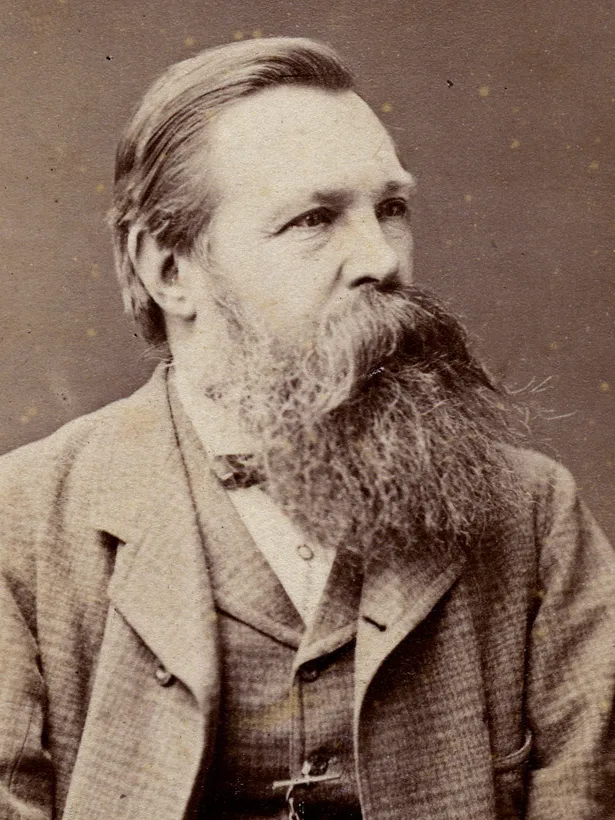
Friedrich Engels (German: [ˈfʁiːdʁɪç ˈɛŋl̩s]; 28 November 1820 – 5 August 1895) was a German philosopher, social and political theorist, journalist, businessman, and revolutionary socialist. He is best known for his lifelong collaboration with Karl Marx, with whom he co-authored The Communist Manifesto (1848) and developed the political and philosophical system that came to be known as Marxism. After Marx's death, Engels served as the editor of his works, completing the second and third volumes of Das Kapital. Born in Barmen, Prussia, to a prosperous mercantile family, Engels rejected his family's devoutly Pietist values from a young age. He became involved with the Young Hegelians while performing military service in Berlin and embraced a materialist philosophy. In 1842, his father sent him to Manchester, England, to work in a cotton mill in which the family had an investment. His experiences of the industrial working class there led him to write his first major work, The Condition of the Working Class in England (1845). In 1844, Engels began a permanent partnership with Marx in Paris. Together they worked to critique the prevailing idealist philosophies and develop their materialist conception of history, notably in The Holy Family (1845) and The German Ideology (unpublished in their lifetimes). They became active in the Communist League, which commissioned them to write the Manifesto. Engels participated actively in the Revolutions of 1848, including in armed combat, before being forced into exile in England. From 1850, he lived in Manchester and worked for the family firm of Ermen & Engels for two decades, leading a double life as a respectable cotton merchant while providing crucial financial support to the impoverished Marx family in London. After retiring in 1870, Engels moved to London and took on a central role in the International Workingmen's Association. Following Marx's death in 1883, he devoted the rest of his life to editing Marx's writings and acting as the leading authority on their shared philosophy. His own works, particularly Anti-Dühring (1878) and Socialism: Utopian and Scientific (1880), were instrumental in popularizing Marxism and became foundational texts for the Second International. Engels's application of dialectics to science in works like Dialectics of Nature was later controversially developed into the state ideology of the Soviet Union. He died of cancer in London in 1895, and his ashes were scattered off Beachy Head.
Quick facts about Friedrich Engels
- Full name: Friedrich Engels
- Born: 1820-11-28
- Nationality: United Kingdom
- Known as: Author
- Wikidata ID: Q34787
Profile compiled from public Wikipedia and Wikidata data. Details can change over time.
Frequently asked questions
Who is Friedrich Engels?
Friedrich Engels (German: [ˈfʁiːdʁɪç ˈɛŋl̩s]; 28 November 1820 – 5 August 1895) was a German philosopher, social and political theorist, journalist, businessman, and revolutionary socialist.
What nationality is Friedrich Engels?
Friedrich Engels is United Kingdom.
When was Friedrich Engels born?
Friedrich Engels was born on 1820-11-28.
Sources
More in Books & Authors
Keep reading