Buddhist Vestment (Kesa) (early 1900s): Art, History and Details
Buddhist Vestment (Kesa) at the Cleveland Museum of Art: early 1900s, silk with supplementary weft, brocaded; metal thread. Explore the work's context, creator attribution and collection history.
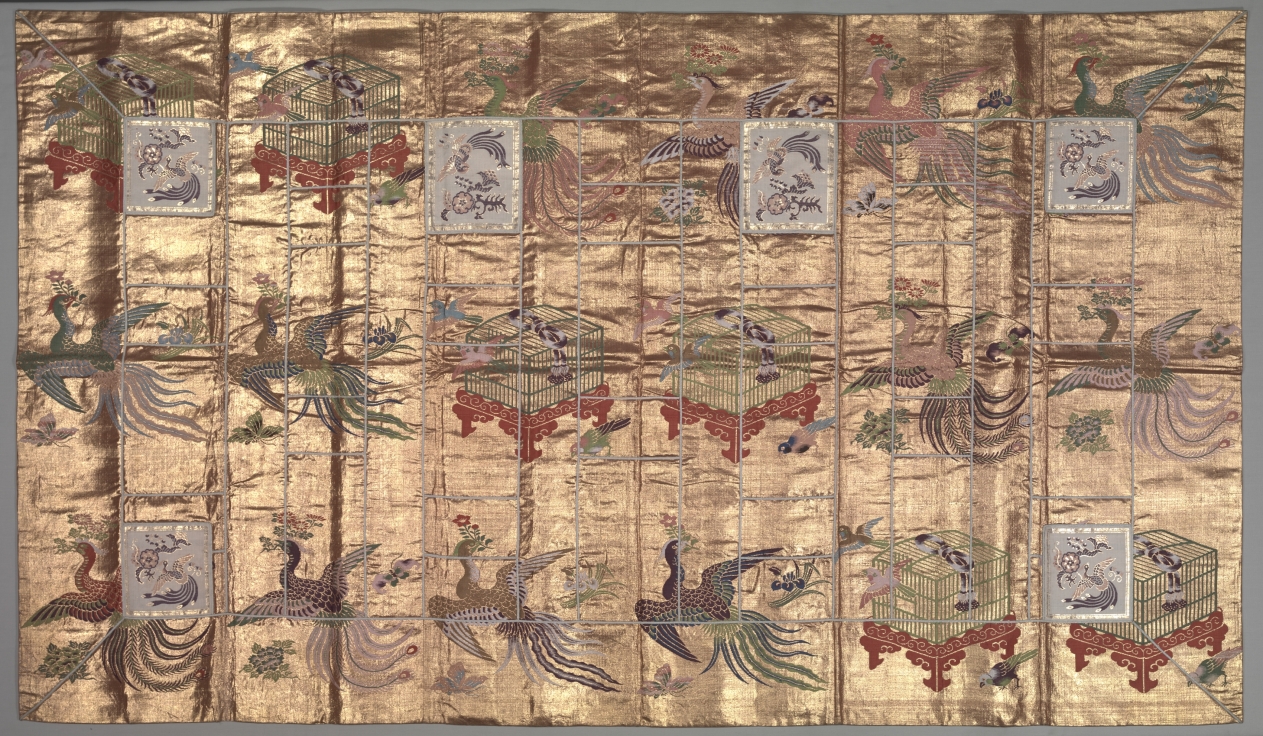
Buddhist Vestment (Kesa) (early 1900s) is in the Cleveland Museum of Art collection.
The work and its context
The museum's open-access catalogue describes the work:
Kesa are Buddhist monastic robes that originated in India. The robes are named after the brown or saffron dye originally used in their production. The primary motif on this seven-paneled kesa is a long-tailed bird with a flower in its mouth. This motif was imported from Persia (present-day Iran) through China during the Nara period (710–794)and is interpreted as a positive symbol. The bird delivers happiness in its mouth.
Object facts
- Title: Buddhist Vestment (Kesa)
- Date: early 1900s
- Culture: Japan, Meiji period (1868–1912)
- Type: Garment
- Technique: silk with supplementary weft, brocaded; metal thread
- Dimensions: Overall: 119.4 x 205.7 cm (47 x 81 in.)
- Collection: Textiles
- Department: Textiles
- Accession number: 1916.1340
A detail from the museum
This kesa depicts bird cages, but all the birds portrayed fly free.
Collection credit
Gift of Mr. and Mrs. J. H. Wade
Further reading listed by the museum
- Cleveland Museum of Art, and Sŏn Sŭng-hye. The Lure of Painted Poetry: Japanese and Korean Art. Cleveland: Cleveland Museum of Art, 2011.
View the collection record
See the museum's photographs and full catalogue entry. Catalogue text is reproduced from the Cleveland Museum of Art's open-access data, with HTML formatting removed. This object and its supplied image are designated CC0.
Sources
More in Fashion & Style
Keep reading