Child’s Coat with Ducks in Pearl Medallions (700s): Art, History and Details
Child’s Coat with Ducks in Pearl Medallions at the Cleveland Museum of Art: 700s, Silk: weft-faced compound twill weave (samite). Explore the work's context, creator attribution and collection history.
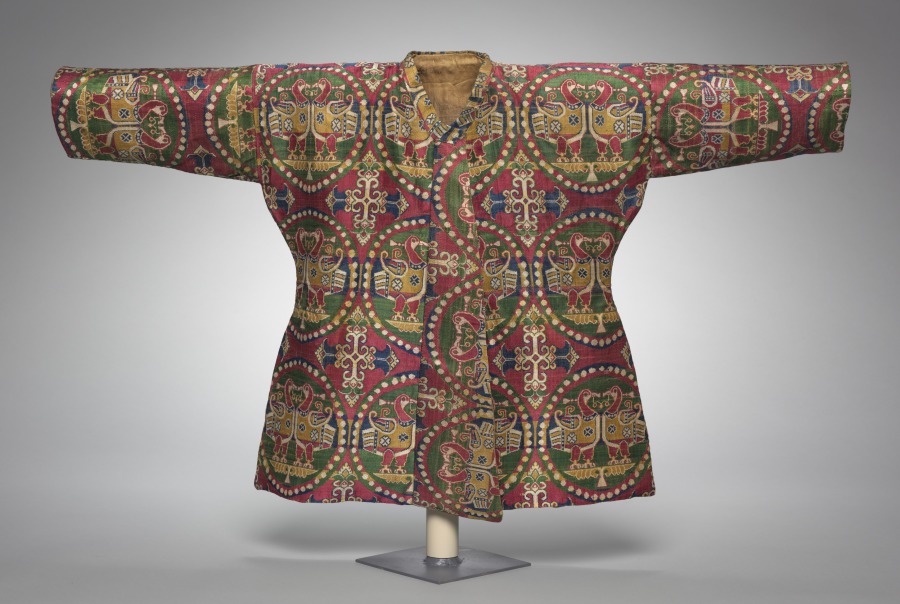
Child’s Coat with Ducks in Pearl Medallions (700s) is in the Cleveland Museum of Art collection.
The work and its context
The museum's open-access catalogue describes the work:
The coat’s outer fabric is woven in five brilliant colors featuring paired ducks in pearl roundels, hallmarks of the precious and highly desired silks from Sogdia. The coat’s inner lining is a twill damask with a floral pattern made in China. The combination of Sogdian and Chinese silks in one garment with Tibetan ownership history is evidence of the vital exchange and cultural interaction among the peoples living along the trade routes of the Silk Road. This precious coat was presumably made for a Tibetan prince. Given the coat’s pristine condition, though, it is unclear whether the garment was ever worn, or was used as a diplomatic gift or perhaps as currency.
Object facts
- Title: Child’s Coat with Ducks in Pearl Medallions
- Date: 700s
- Culture: Probably Sogdia (present-day Uzbekistan); China, Tang dynasty
- Type: Garment
- Technique: Silk: weft-faced compound twill weave (samite)
- Dimensions: width across shoulders: 84.5 cm (33 1/4 in.); length back of neck to hem: 51.4 cm (20 1/4 in.)
- Collection: Textiles
- Department: Textiles
- Accession number: 1996.2.1
A detail from the museum
This coat is part of a set of garments that originally included an outer pair of pants and silk boots made from the same fabric.
Collection credit
Purchase from the J. H. Wade Fund
Further reading listed by the museum
- Cleveland Museum of Art, “The Cleveland Museum of Art Acquires Major Works,” March 18, 1996, Cleveland Museum of Art Archives.
- Watt, James C. Y., Anne E. Wardwell, and Morris Rossabi. When silk was gold: Central Asian and Chinese textiles. New York: Metropolitan Museum of Art in cooperation with the Cleveland Museum of Art: Distributed by H.N. Abrams, 1997.
- Mackie, Louise W. Symbols of Power: Luxury Textiles from Islamic Lands, 7th-21st Century. Cleveland; New Haven: Cleveland Museum of Art; Yale University Press, 2015.
View the collection record
See the museum's photographs and full catalogue entry. Catalogue text is reproduced from the Cleveland Museum of Art's open-access data, with HTML formatting removed. This object and its supplied image are designated CC0.
Sources
More in Fashion & Style
Keep reading