Headcloth (Yakan seputangan) (c. early 1900s): Art, History and Details
Headcloth (Yakan seputangan) at the Cleveland Museum of Art: c. early 1900s, plain weave with paired weft: cotton; supplementary weft: silk. Explore the work's context, creator attribution and collection history.
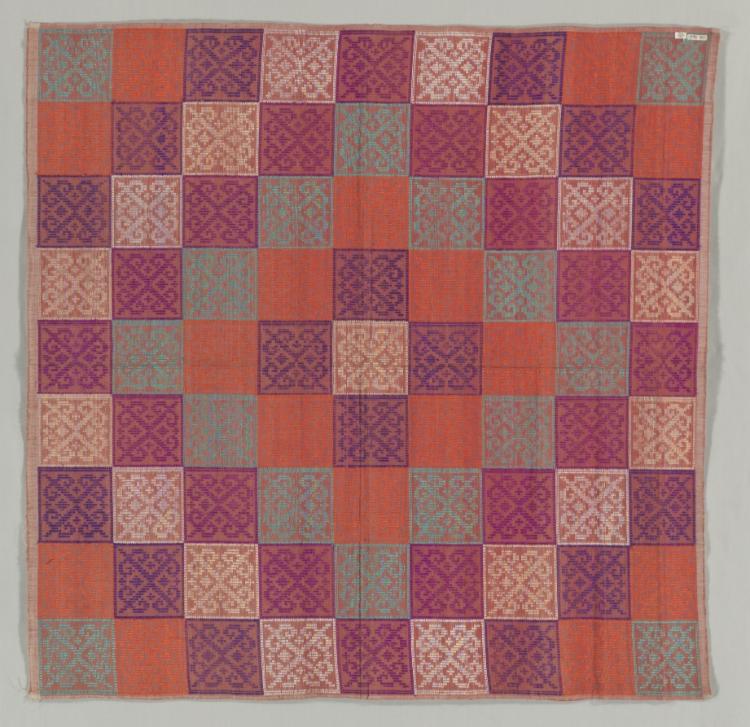
Headcloth (Yakan seputangan) (c. early 1900s) is in the Cleveland Museum of Art collection.
The work and its context
The museum's open-access catalogue describes the work:
This seputangan (headcloth) was produced by the Yakan people of Basilan, and worn by men in ceremonial, formal, and dress contexts. The cloth was woven on a back-strap loom with a cotton warp and patterned using supplementary-weft silk, which produces the characteristic lustrous motifs across the surface. The vivid, high-contrast color combinations are characteristic of Yakan ceremonial textiles.
Object facts
- Title: Headcloth (Yakan seputangan)
- Date: c. early 1900s
- Culture: Philippines
- Type: Garment
- Technique: plain weave with paired weft: cotton; supplementary weft: silk
- Dimensions: Overall: 97.5 x 95 cm (38 3/8 x 37 3/8 in.)
- Collection: Textiles
- Department: Textiles
- Accession number: 1917.746
A detail from the museum
This textile’s geometric intensity recalls the Tausug pis siyabit, but is technically and culturally distinct.
Collection credit
Gift of Mrs. G. Field Adams
View the collection record
See the museum's photographs and full catalogue entry. Catalogue text is reproduced from the Cleveland Museum of Art's open-access data, with HTML formatting removed. This object and its supplied image are designated CC0.
Sources
More in Fashion & Style
Keep reading