Ornament from a Garment (400s–600s CE): Art, History and Details
Ornament from a Garment at the Cleveland Museum of Art: 400s–600s CE, Linen, undyed; wool, dyed; tapestry weave with supplementary weft wrapping. Explore the work's context, creator attribution and collection history.
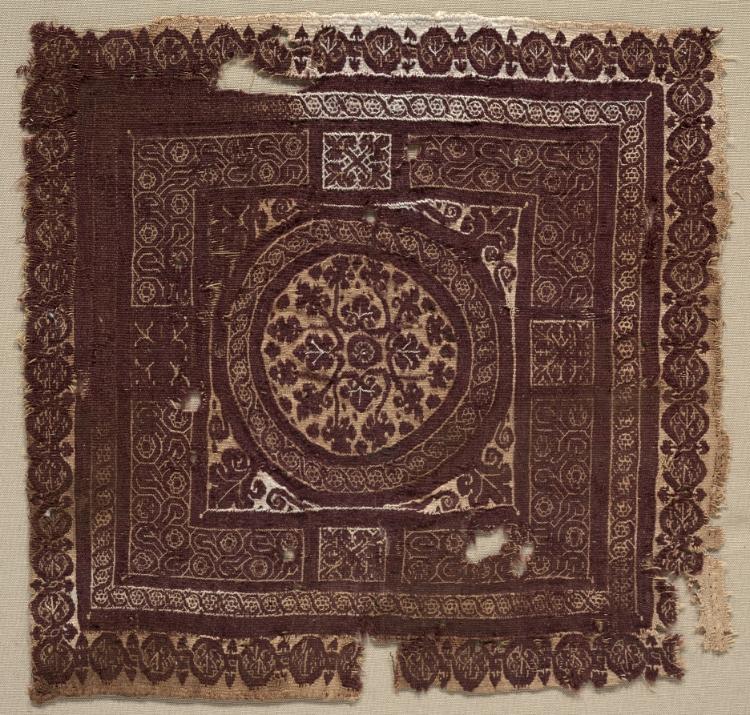
Ornament from a Garment (400s–600s CE) is in the Cleveland Museum of Art collection.
The work and its context
The museum's open-access catalogue describes the work:
Six different designs of leaves and interlacing lines are organized harmoniously here within circles, triangles, and squares. Originally part of a garment, interlacing knot designs were thought to symbolically protect the wearer from harm.
Object facts
- Title: Ornament from a Garment
- Date: 400s–600s CE
- Culture: Egypt, Byzantine period
- Type: Textile
- Technique: Linen, undyed; wool, dyed; tapestry weave with supplementary weft wrapping
- Dimensions: Overall: 25.4 x 24.8 cm (10 x 9 3/4 in.); Mounted: 38.1 x 38.1 cm (15 x 15 in.)
- Collection: T - Coptic
- Department: Textiles
- Accession number: 1919.21
A detail from the museum
The purple color was achieved using red dye made of madder and blue from the indigo plant.
Collection credit
Dudley P. Allen Fund
Further reading listed by the museum
- "Accessions." The Bulletin of the Cleveland Museum of Art 6, no. 2 (1919): 37-38.
View the collection record
See the museum's photographs and full catalogue entry. Catalogue text is reproduced from the Cleveland Museum of Art's open-access data, with HTML formatting removed. This object and its supplied image are designated CC0.
Sources
More in Fashion & Style
Keep reading