Cap (1800s): Art, History and Details
Cap at the Cleveland Museum of Art: 1800s, Velvet embroidered with gilt-silver–wrapped silk thread (zari); silk: lining; rubies, pearls, and spinels. Explore the work's context, creator attribution and collection history.
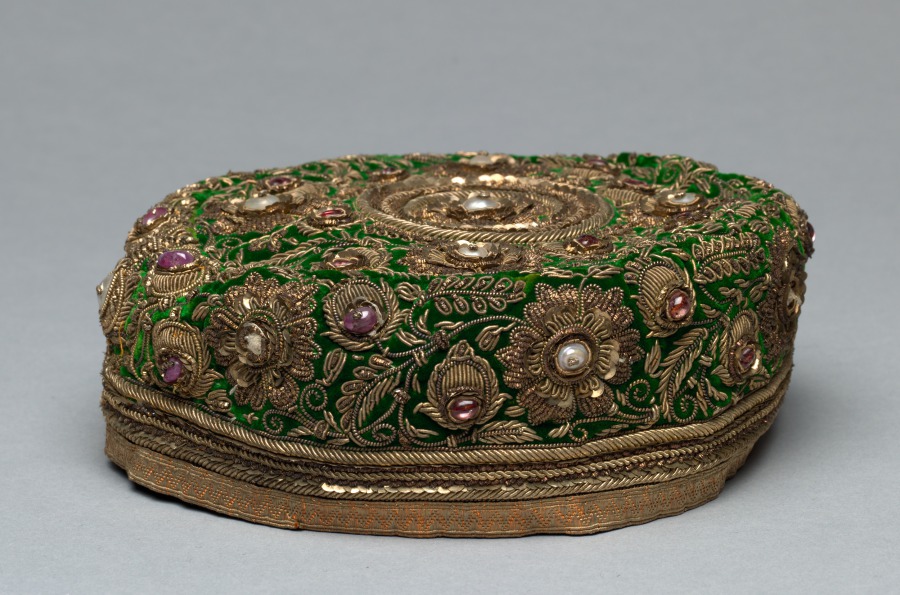
Cap (1800s) is in the Cleveland Museum of Art collection.
The work and its context
The museum's open-access catalogue describes the work:
Historically in India, head coverings were worn in outdoor and formal contexts and can signal age, allegiance, and status among Indian men and boys. A low round cap such as this was worn primarily by the well-educated aristocratic boys in the king’s circle. The painstaking process of creating the ornament involved wrapping gilt-silver wire of various dimensions around a silk thread core to create a textured appearance for the flowers and vines.
Object facts
- Title: Cap
- Date: 1800s
- Culture: India
- Type: Garment
- Technique: Velvet embroidered with gilt-silver–wrapped silk thread (zari); silk: lining; rubies, pearls, and spinels
- Dimensions: Overall: 6.3 x 15.2 x 15.2 cm (2 1/2 x 6 x 6 in.)
- Collection: Textiles
- Department: Textiles
- Accession number: 1916.1477
A detail from the museum
The semiprecious rose-colored spinels were considered a talisman for military victory.
Collection credit
Gift of Mr. and Mrs. J. H. Wade
Further reading listed by the museum
- Kumar, Ritu, and Cathy Muscat. Costumes and Textiles of Royal India. London: Christie's Books, 1999.
- Swarup, Sushama. Costumes & Textiles of Awadh: From the Era of Nawabs to Modern Times. 2012.
View the collection record
See the museum's photographs and full catalogue entry. Catalogue text is reproduced from the Cleveland Museum of Art's open-access data, with HTML formatting removed. This object and its supplied image are designated CC0.
Sources
More in Fashion & Style
Keep reading