Garment (c. 1890s): Art, History and Details
Garment at the Cleveland Museum of Art: c. 1890s, Silk, mirrored glass. Explore the work's context, creator attribution and collection history.
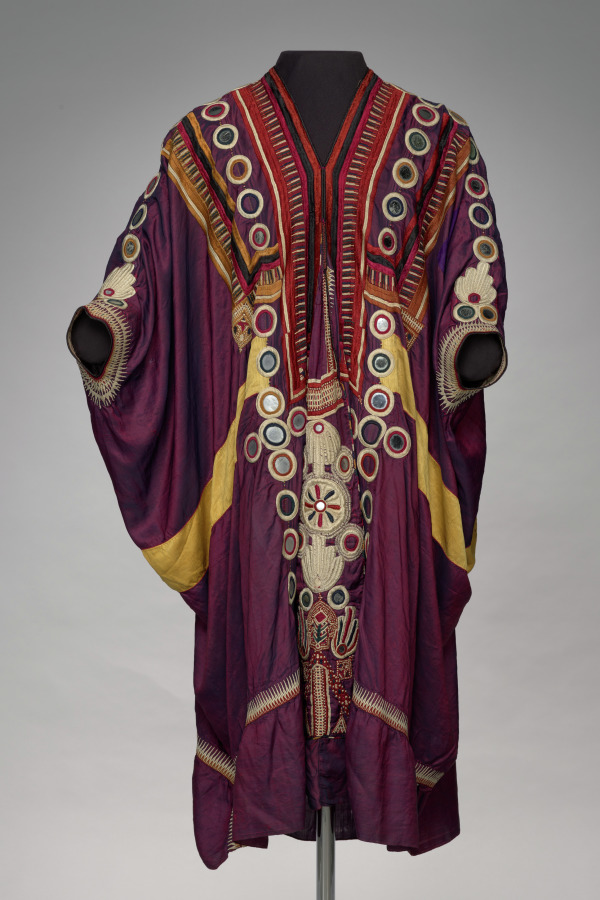
Garment (c. 1890s) is in the Cleveland Museum of Art collection.
The work and its context
The museum's open-access catalogue describes the work:
Covered with symbolic decorations, this multitone silk garment beautified and protected its wearer. The khamsah (خمسة)—an open five-fingered hand—figures prominently as a cream-colored appliqué. The khamsah deflected or absorbed al-'ayn (العين)—the evil eye—as did the appliquéd mirrors, shielding the wearer from many varieties of harm. New research connects this garment to an entry in museum founder J. H. Wade’s 1881–1900 travel purchase notebook: “Kalifa’s gown emb[roidered] on purple silk.” A caliph (or khalifah) is a leader of a Caliphate (Islamic state) or an Islamic religious group. Whether this was indeed a caliph’s gown is a point of future research.
Object facts
- Title: Garment
- Date: c. 1890s
- Culture: Africa, North Africa, Egypt, Aswan, unidentified makers
- Type: Garment
- Technique: Silk, mirrored glass
- Dimensions: Overall: 132.1 x 63.5 x 30.5 cm (52 x 25 x 12 in.)
- Collection: Textiles
- Department: Textiles
- Accession number: 1916.1472
A detail from the museum
Folds and old stitch lines on the sides of this garment indicate that it was taken in at one time, making it shorter and suggesting that more than one person wore it.
Collection credit
Gift of Mr. and Mrs. J. H. Wade
View the collection record
See the museum's photographs and full catalogue entry. Catalogue text is reproduced from the Cleveland Museum of Art's open-access data, with HTML formatting removed. This object and its supplied image are designated CC0.
Sources
More in Fashion & Style
Keep reading