Headdress (1900s): Art, History and Details
Headdress at the Cleveland Museum of Art: 1900s, African gray parrot feathers, wood, plant fiber, probably cotton, string, and colorant. Explore the work's context, creator attribution and collection history.
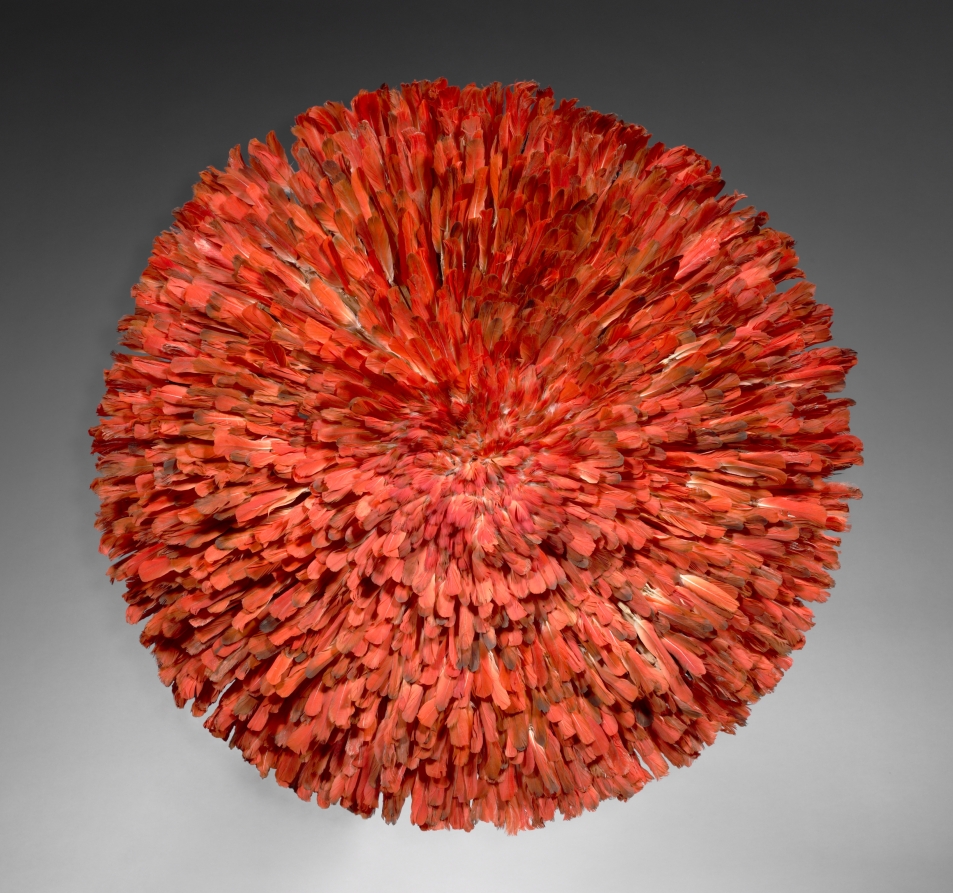
Headdress (1900s) is in the Cleveland Museum of Art collection.
The work and its context
The museum's open-access catalogue describes the work:
Hundreds of red tail feathers from the grey parrot (Psittacus erithacus) decorate this disk-shaped headdress. Only the king, some high-ranking individuals, and members of the all-male elephant society—known in different languages as Kuosi, Nekang, or Kem-ndze—wore this prestigious headgear at ceremonies and funerals. Typically, the headdress was worn pushed slightly back from the hairline. When used by members of the elephant society, it was accompanied by a cloth and glass bead mask (mbap mteng) in the shape of that animal, such as 1985.1082.
Object facts
- Title: Headdress
- Date: 1900s
- Culture: Africa, Central Africa, Cameroon, Grassfields region, Bamileke-style maker
- Type: Garment
- Technique: African gray parrot feathers, wood, plant fiber, probably cotton, string, and colorant
- Dimensions: Diameter: 90 cm (35 7/16 in.)
- Collection: African Art
- Department: African Art
- Accession number: 2007.181
A detail from the museum
This headdress has an ingenious built-in storage system: it can be flipped inside out to encase the feathers within a rigid woven structure, protecting them during storage or travel.
Collection credit
Sundry Purchase Fund
Further reading listed by the museum
- Petridis, Constantine. "New Acquisitions of African Art at the Cleveland Museum of Art". African Arts, 44, no. 1, (Spring 2011): 52-67.
View the collection record
See the museum's photographs and full catalogue entry. Catalogue text is reproduced from the Cleveland Museum of Art's open-access data, with HTML formatting removed. This object and its supplied image are designated CC0.
Sources
More in Fashion & Style
Keep reading