Semi-formal Court Robe (Jifu) (late 1700s): Art, History and Details
Semi-formal Court Robe (Jifu) at the Cleveland Museum of Art: late 1700s, Silk: satin weave; silk and metal thread: embroidery. Explore the work's context, creator attribution and collection history.
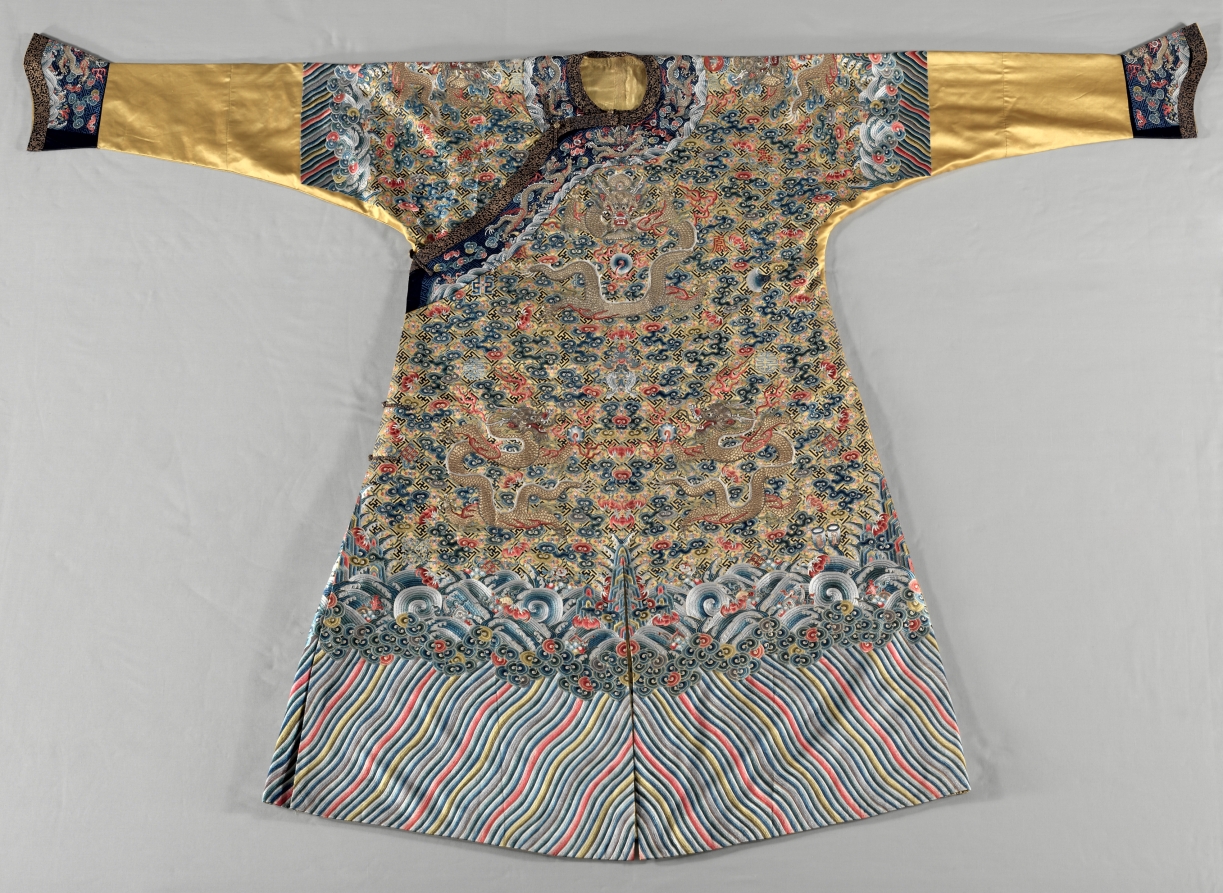
Semi-formal Court Robe (Jifu) (late 1700s) is in the Cleveland Museum of Art collection.
The work and its context
The museum's open-access catalogue describes the work:
The lavishly embroidered motifs of dragons, clouds, waves, and rocks on this robe form a diagram that symbolizes the universe: the lower horizontal band of waves at the hem represents the oceans that surround the earth, while the prism-shaped rocks emerging from the waves at the sides, front, and back of the coat symbolize the earth. The cloud-filled firmament above the waves shows dragons—symbols of imperial authority. During the Qing dynasty, yellow indicated “imperial” and the color’s use in garments was reserved for the emperor and his consorts. The emperor would have worn this type of court robe at semi-official meetings at court but not when he performed the official state rituals.
Object facts
- Title: Semi-formal Court Robe (Jifu)
- Date: late 1700s
- Culture: China, Qing dynasty (1644–1911), Jiaqing period (1796–1820)
- Type: Garment
- Technique: Silk: satin weave; silk and metal thread: embroidery
- Dimensions: width across shoulders: 226.1 cm (89 in.); length back of neck to hem: 154.9 cm (61 in.)
- Collection: Textiles
- Department: Textiles
- Accession number: 1983.32
A detail from the museum
Look for the red bats embroidered throughout the robe. They are lucky symbols, because the words for “bat” and for “luck” are homophones, both pronounced “fu."
Collection credit
Purchase from the J. H. Wade Fund
Further reading listed by the museum
- Vollmer, John. In the Presence of the Dragon Throne: Chʻing Dynasty Costume (1644-1911) in the Royal Ontario Museum. Toronto: Royal Ontario Museum, 1977.
- Cleveland Museum of Art. Images of the Mind. Cleveland, Ohio: Cleveland Museum of Art, 1987.
- Wilson, J. Keith. "Powerful Form and Potent Symbol: The Dragon in Asia." The Bulletin of the Cleveland Museum of Art 77, no. 8 (1990): 286-323.
View the collection record
See the museum's photographs and full catalogue entry. Catalogue text is reproduced from the Cleveland Museum of Art's open-access data, with HTML formatting removed. This object and its supplied image are designated CC0.
Sources
More in Fashion & Style
Keep reading