Man's Garment (possibly early 1900s): Art, History and Details
Man's Garment at the Cleveland Museum of Art: possibly early 1900s, Raffia palm fiber (Raphia ruffia or R. vinifera) and dye. Explore the work's context, creator attribution and collection history.
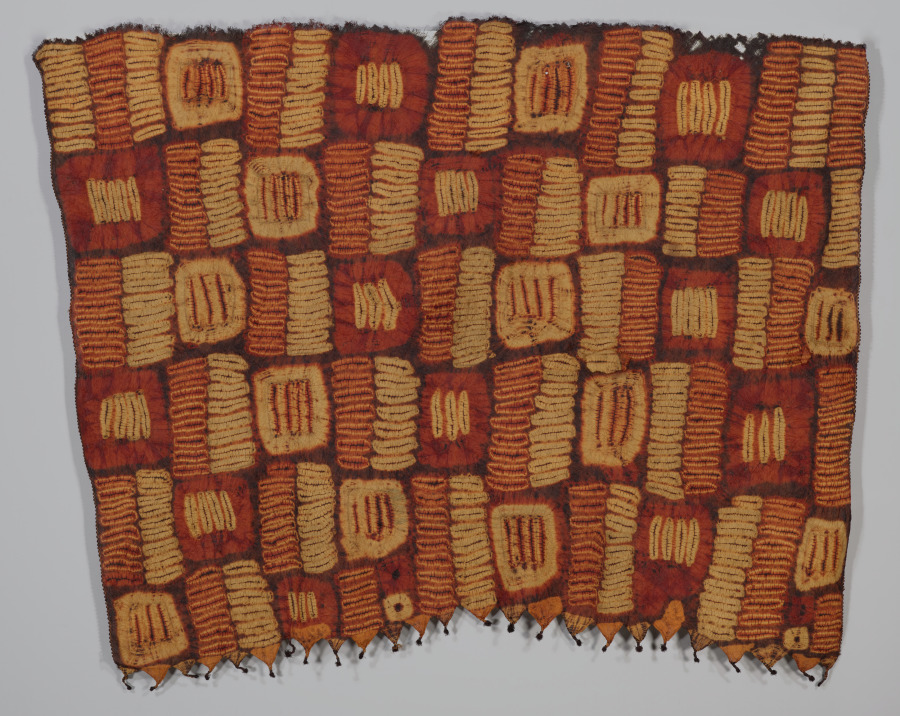
Man's Garment (possibly early 1900s) is in the Cleveland Museum of Art collection.
The work and its context
The museum's open-access catalogue describes the work:
Displayed flat to highlight its designs and preserve its delicate fibers, this wrapper was meant to drape around the body. An elite man wore it with one corner over a shoulder, the knotted fringe skimming his ankles. The garment gained its earth-toned geometric patterns through plangi, a knot-and-twist resist dyeing technique; each color is applied in a different dye bath, from lightest to darkest. While their patterns are unique, these garments reflect regional influence: Dida women likely learned hand interlacing from Liberian Kpelle weavers. Such garments were given as gifts or worn on special occasions, at least into the 1990s.
Object facts
- Title: Man's Garment
- Date: possibly early 1900s
- Culture: Africa, West Africa, Côte d'Ivoire, Dida-style weavers and dyers
- Type: Textile
- Technique: Raffia palm fiber (Raphia ruffia or R. vinifera) and dye
- Dimensions: Overall: 169.8 x 211.5 cm (66 7/8 x 83 1/4 in.)
- Collection: T - African
- Department: Textiles
- Accession number: 2003.89
A detail from the museum
The tying of fabric during the making of this garment gives its surface a distinctively "crinkled" texture.
Collection credit
John L. Severance Fund
Further reading listed by the museum
- Adams, Monni, and T. Rose Holdcraft. 1992. “Dida Woven Raffia Cloth from Côte D'ivoire.” African Arts 25 (3): 42–101.
- Gillow, John. African Textiles: Colour and Creativity Across a Continent. London: Thames & Hudson, 2003.
View the collection record
See the museum's photographs and full catalogue entry. Catalogue text is reproduced from the Cleveland Museum of Art's open-access data, with HTML formatting removed. This object and its supplied image are designated CC0.
Sources
More in Fashion & Style
Keep reading