Tibetan Man's Robe, Chuba (late 1600s): Art, History and Details
Tibetan Man's Robe, Chuba at the Cleveland Museum of Art: late 1600s, Silk, gilt-metal thread of two kinds: satin weave with supplementary weft patterning. Explore the work's context, creator attribution and collection history.
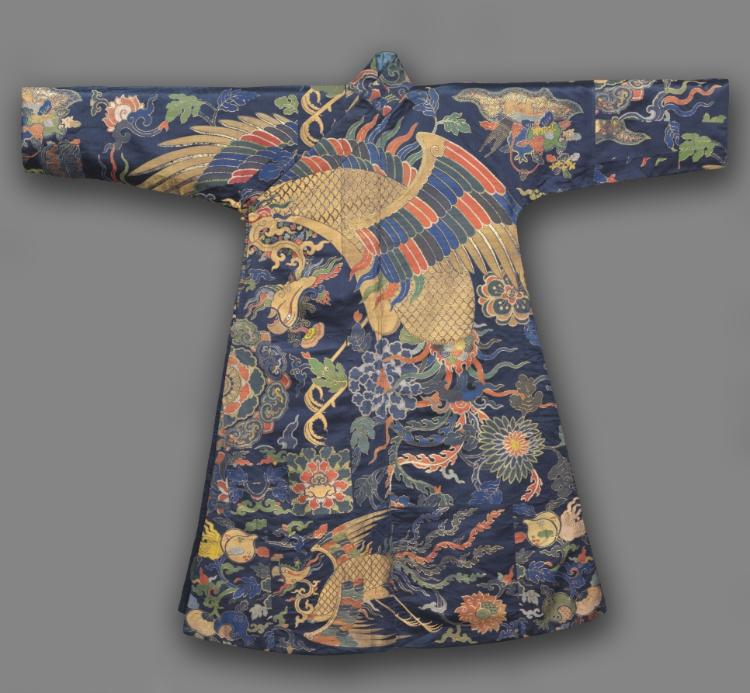
Tibetan Man's Robe, Chuba (late 1600s) is in the Cleveland Museum of Art collection.
The work and its context
The museum's open-access catalogue describes the work:
This magnificent robe for a Tibetan lama or an aristocrat was originally a Chinese imperial wall hanging. Tibetan tailors cut it into 60 separate units, reassembling the fabric for a completely new and bold design. The wearer of such a garment must have impressed bystanders by his striking appearance. What you see here is the robe’s back side. Textiles played an important role in Chinese diplomacy with foreign governments. Diplomatic gifts of silk served to pacify border populations and to maintain balanced power relationships. Over centuries the Chinese court endeavored to keep a stable relationship with powerful Tibetan Buddhists. During the Qing dynasty (1644–1911) the Chinese court began to send gifts of court garments and furnishings to Tibet where they were altered to create Tibetan-style robes.
Object facts
- Title: Tibetan Man's Robe, Chuba
- Date: late 1600s
- Culture: China, Qing dynasty (1644-1911), Kangxi period (1662-1772)
- Type: Garment
- Technique: Silk, gilt-metal thread of two kinds: satin weave with supplementary weft patterning
- Dimensions: width across shoulders: 189.9 cm (74 3/4 in.); length back of neck to hem: 152.4 cm (60 in.)
- Collection: Textiles
- Department: Textiles
- Accession number: 2007.216
A detail from the museum
Large, splendid gold-thread phoenixes have pride of place on the front and back of the robe, complemented by two smaller but equally resplendent phoenixes below.
Collection credit
Norman O. Stone and Ella A. Stone Memorial Fund
Further reading listed by the museum
- Vollmer, John, Thierry Prat, and Richard Sheppard. Silks for Thrones and Altars: Chinese Costumes and Textiles : From the Liao through the Qing Dynasty. Paris: Myrna Myers, 2003.
- Cleveland Museum of Art. The CMA Companion: A Guide to the Cleveland Museum of Art. Cleveland: Cleveland Museum of Art, 2014.
- "New in the Galleries.” Cleveland Art: Cleveland Museum of Art Members Magazine 58. no. 1 (January/February 2018): Back cover.
View the collection record
See the museum's photographs and full catalogue entry. Catalogue text is reproduced from the Cleveland Museum of Art's open-access data, with HTML formatting removed. This object and its supplied image are designated CC0.
Sources
More in Fashion & Style
Keep reading