A Couple (from the series Costumes and Professions) (mid-1800s): Art, History and Details
A Couple (from the series Costumes and Professions) at the Cleveland Museum of Art: mid-1800s, Gum tempera, ink, and gold on paper. Explore the work's context, creator attribution and collection history.
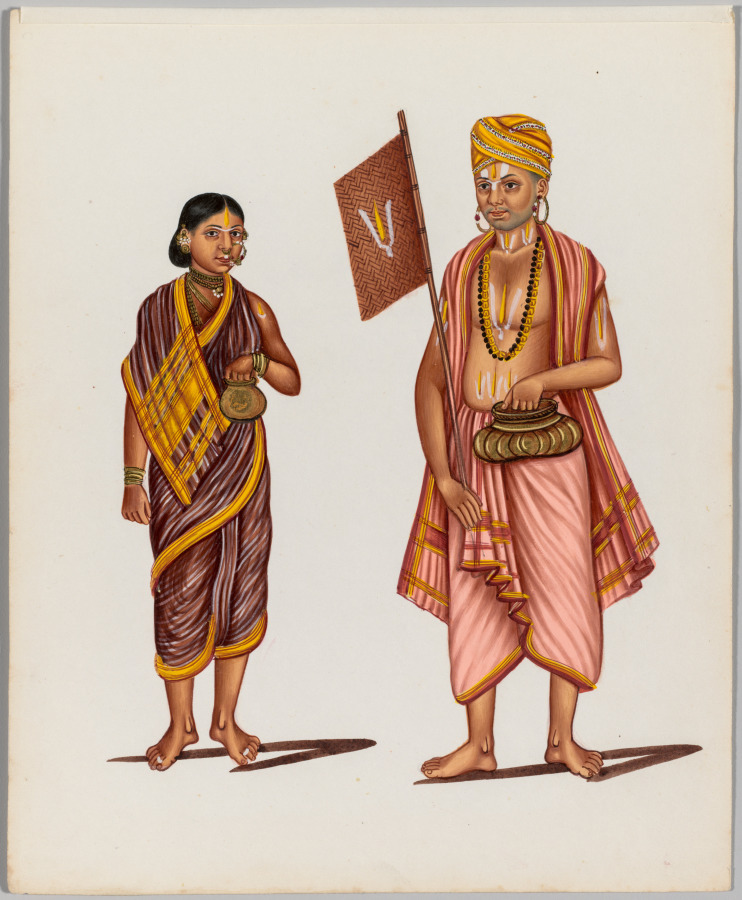
A Couple (from the series Costumes and Professions) (mid-1800s) is in the Cleveland Museum of Art collection.
The work and its context
The museum's open-access catalogue describes the work:
This work was made by Indian artists for a member of the British East India Company. It was painted in the southern style of Company school painting, which is distinguished by its bold outlines, saturated color, and heavy application of gold. The priest on the right bears the sectarian markings of a follower of the Hindu god Vishnu on his forehead, chest, arms, and flag. A 19th-century British inscription on its surviving fly sheet, a protective cover of tissue paper, states that this priest made his living by praying to the “native doorway” early every morning. The survival of this commentary reveals how British collectors used these apparently objective depictions of costumes and professions to implicate Indian holy men in strange or even charlatan behavior.
Object facts
- Title: A Couple (from the series Costumes and Professions)
- Date: mid-1800s
- Culture: South India, Tanjore, 19th century
- Type: Painting
- Technique: Gum tempera, ink, and gold on paper
- Dimensions: Overall: 24.1 x 19.9 cm (9 1/2 x 7 13/16 in.)
- Collection: Indian Art
- Department: Indian and Southeast Asian Art
- Accession number: 2001.164
Collection credit
Gift of William E. Ward in memory of his wife, Evelyn Svec Ward
View the collection record
See the museum's photographs and full catalogue entry. Catalogue text is reproduced from the Cleveland Museum of Art's open-access data, with HTML formatting removed. This object and its supplied image are designated CC0.
Sources
More in Lifestyle
Keep reading