A Hussar Officer on Horseback (1812): Art, History and Details
A Hussar Officer on Horseback at the Cleveland Museum of Art: 1812, black and white chalk. Explore the work's context, creator attribution and collection history.
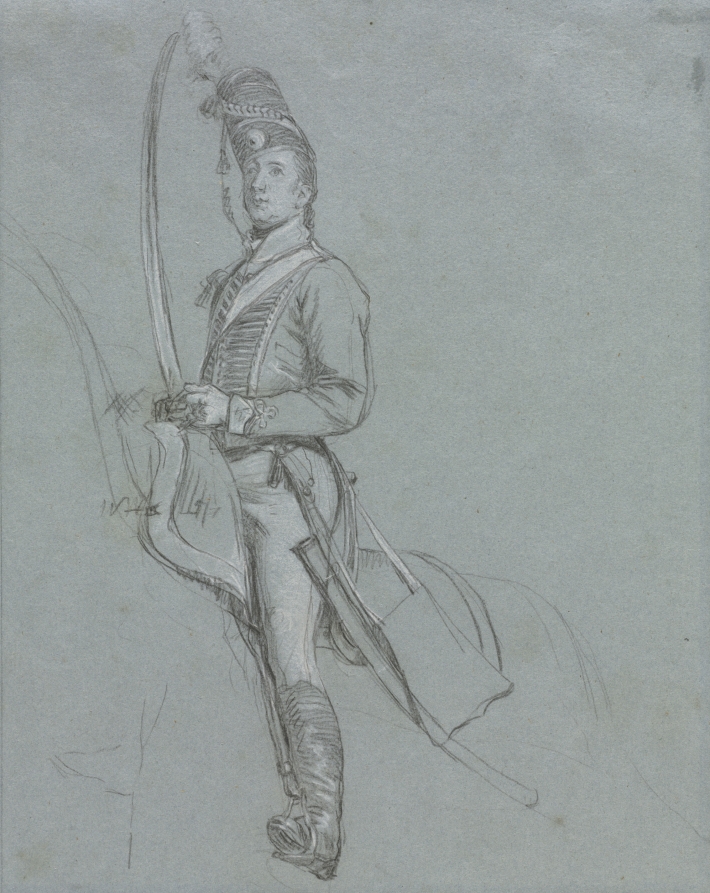
A Hussar Officer on Horseback (1812) is in the Cleveland Museum of Art collection. The museum's creator attribution is John Singleton Copley (American, born The Thirteen Colonies, 1738–1815).
The work and its context
The museum's open-access catalogue describes the work:
John Singleton Copley left Boston at the start of the American Revolution in 1775 to pursue his career in England, where he achieved distinction both as a portraitist and a history painter. Following a method often employed in France, Copley generally drew on blue paper to serve as a middle tone, working up the image using black chalk to indicate outlines and shadows, and white chalk for highlights. He made this drawing as an early study for the figure of the prince of Orange in his last major history painting, Battle of the Pyrenees (Museum of Fine Arts, Boston), in 1812–15. The figure is garbed in the uniform of a “hussar,” a light cavalry officer equipped with a saber, regiments of which played an important role in the Napoleonic Wars (1803–15). In the final composition, Copley used the pose not for Orange, but for the Duke of Wellington, changing the facial features and adjusting the position of the figure’s arms.
Object facts
- Title: A Hussar Officer on Horseback
- Date: 1812
- Creator attribution: John Singleton Copley (American, born The Thirteen Colonies, 1738–1815)
- Culture: America
- Type: Drawing
- Technique: black and white chalk
- Dimensions: Sheet: 27.6 x 22.1 cm (10 7/8 x 8 11/16 in.)
- Collection: DR - American 18th Century
- Department: Drawings
- Accession number: 1950.216
A detail from the museum
The soldier wears a heavy military headdress called a “busby,” originally worn by Hungarian hussars and adopted by American hussar (light cavalry) regiments during the 1800s.
Collection credit
Norman O. Stone and Ella A. Stone Memorial Fund
Further reading listed by the museum
- Amory, Martha Babcock. The Domestic and Artistic Life of John Singleton Copley, RA. Boston, MA: Houghton, Mifflin and Co., 1882.
- Comstock, Helen. “Exhibition of Drawings by Copley.” Panorama by Harry Shaw Newman Gallery 2, no. 9 (May 2, 1947): 100-108.
View the collection record
See the museum's photographs and full catalogue entry. Catalogue text is reproduced from the Cleveland Museum of Art's open-access data, with HTML formatting removed. This object and its supplied image are designated CC0.
Sources
More in Lifestyle
Keep reading