A prince riding a composite elephant (c. 1590): Art, History and Details
A prince riding a composite elephant at the Cleveland Museum of Art: c. 1590, Gum tempera, ink, and gold on paper. Explore the work's context, creator attribution and collection history.
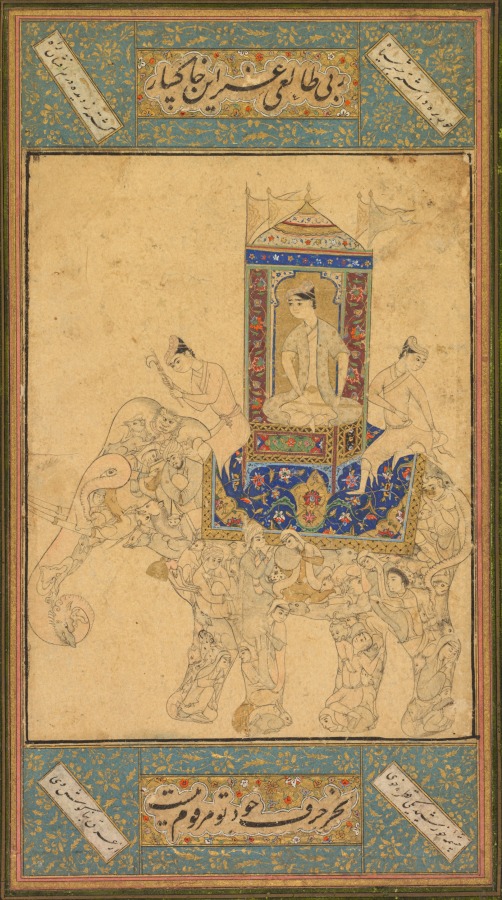
A prince riding a composite elephant (c. 1590) is in the Cleveland Museum of Art collection.
The work and its context
The museum's open-access catalogue describes the work:
A prince sits cross-legged in a covered howdah seat secured to the back of a royal elephant with golden rings on its tusks. The elephant is being driven by attendants, one of whom holds a goad. Artists in the southern Indian region known as the Deccan expanded upon Persian practices of embedding creatures in landscape scenes—like a visual double-entendre—and created inventive images of composite creatures made up of figures that invite extended close looking. This painting would have been mounted in an album that was brought out for entertainment in elite intimate gatherings.
Object facts
- Title: A prince riding a composite elephant
- Date: c. 1590
- Culture: India, Golconda, Deccan, 16th century
- Type: Painting
- Technique: Gum tempera, ink, and gold on paper
- Dimensions: Page: 28.8 x 18.6 cm (11 5/16 x 7 5/16 in.); Painting: 14.5 x 11 cm (5 11/16 x 4 5/16 in.)
- Collection: Indian Art
- Department: Indian and Southeast Asian Art
- Accession number: 2013.282
A detail from the museum
Two lions share one head at the top of the elephant’s head.
Collection credit
Gift in honor of Madeline Neves Clapp; Gift of Mrs. Henry White Cannon by exchange; Bequest of Louise T. Cooper; Leonard C. Hanna Jr. Fund; From the Catherine and Ralph Benkaim Collection
Further reading listed by the museum
- Eappen, Omana. "Bagh-i-Nauras and the Aesthetics of Well-Being." In Rethinking Comparative Aesthetics in a Contemporary Frame, edited by R. N. Misra, and Parul Dave-Mukherji, 273–326. Shimla: Indian Institute of Advanced Study, 2019.
View the collection record
See the museum's photographs and full catalogue entry. Catalogue text is reproduced from the Cleveland Museum of Art's open-access data, with HTML formatting removed. This object and its supplied image are designated CC0.
Sources
More in Lifestyle
Keep reading