A saddled horse (c. 1750): Art, History and Details
A saddled horse at the Cleveland Museum of Art: c. 1750, Gum tempera on paper. Explore the work's context, creator attribution and collection history.
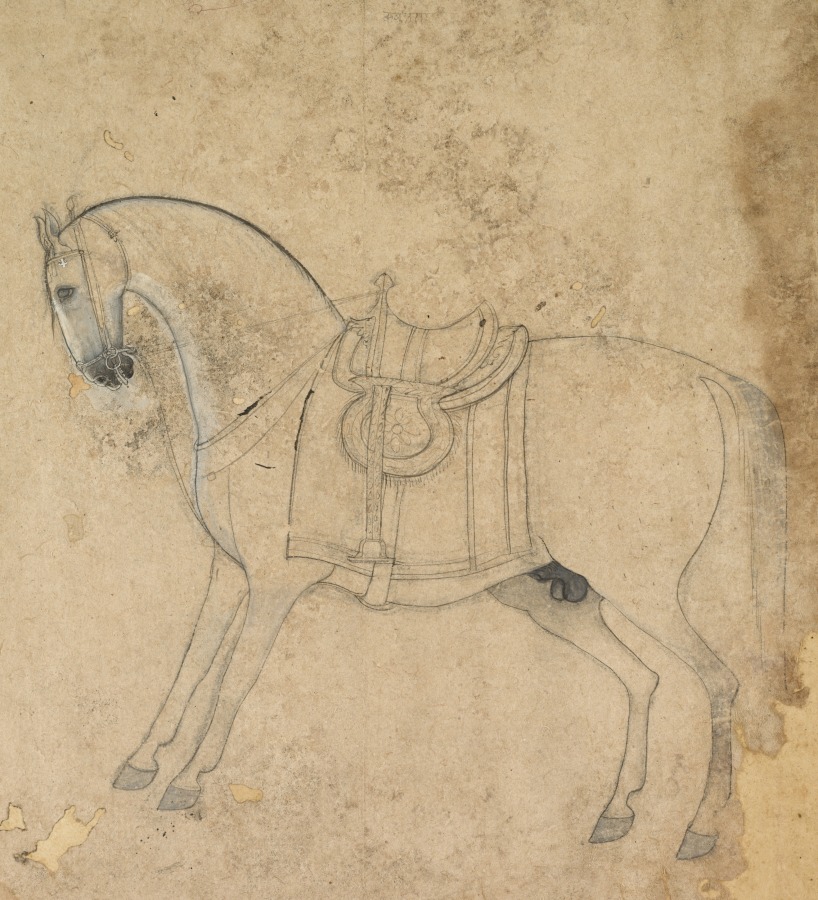
A saddled horse (c. 1750) is in the Cleveland Museum of Art collection.
The work and its context
The museum's open-access catalogue describes the work:
Horses were important components in royal portraiture, processions, ragamalas (series of images related to verses associated with musical compositions), and narrative scenes. Kings also commissioned portraits of their favorite steeds. Pahari artists perfected their ability to depict horses by sketching with brushes and black pigment on handmade paper.
Object facts
- Title: A saddled horse
- Date: c. 1750
- Culture: Northern India, Pahari kingdoms
- Type: Drawing
- Technique: Gum tempera on paper
- Dimensions: Overall: 24.5 x 21.5 cm (9 5/8 x 8 7/16 in.)
- Collection: Indian Art
- Department: Indian and Southeast Asian Art
- Accession number: 1968.106
A detail from the museum
White pigment was used to cover lines that the artist considered to be less than perfect.
Collection credit
Gift of the Folio Club
Further reading listed by the museum
- Leach, Linda York. Indian Miniature Paintings and Drawings. Cleveland, OH: Cleveland Museum of Art in cooperation with Indiana University Press, 1986.
View the collection record
See the museum's photographs and full catalogue entry. Catalogue text is reproduced from the Cleveland Museum of Art's open-access data, with HTML formatting removed. This object and its supplied image are designated CC0.
Sources
More in Lifestyle
Keep reading