Act VII from the series The Storehouse of Loyal Retainers (c. 1801–2): Art, History and Details
Act VII from the series The Storehouse of Loyal Retainers at the Cleveland Museum of Art: c. 1801–2, Color woodblock print; ink and color on paper. Explore the work's context, creator attribution and collection history.
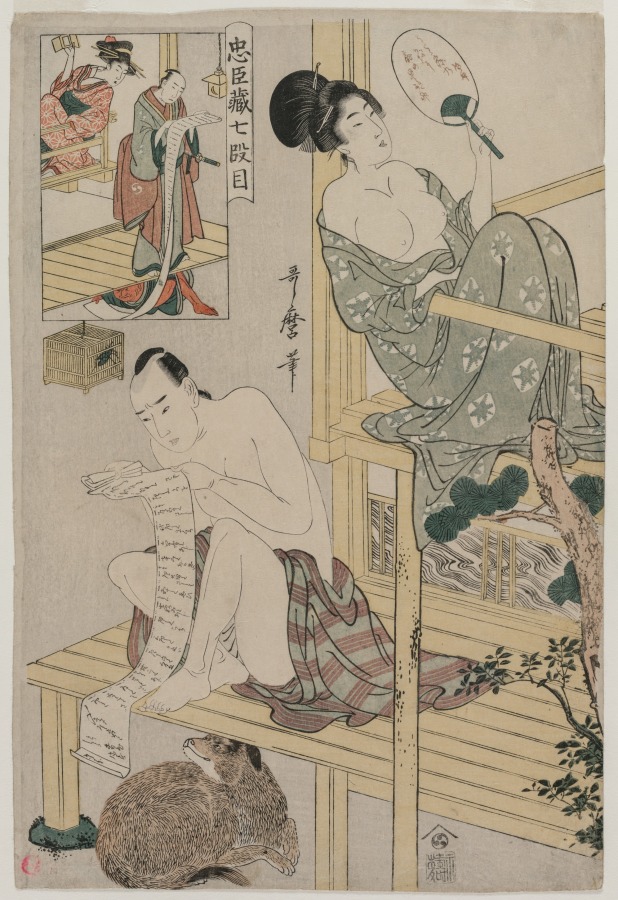
Act VII from the series The Storehouse of Loyal Retainers (c. 1801–2) is in the Cleveland Museum of Art collection. The museum's creator attribution is Kitagawa Utamaro (Japanese, c. 1754–1806).
The work and its context
The museum's open-access catalogue describes the work:
This series gives a famous play a humorous spin by altering the setting and some parts of the narrative. Utamaro kept his jokes accessible by picturing the action of the original episode to the side of the main image for easy reference. In this print, a spy reading a letter is turned into a dog; both can be pronounced inu in Japanese. In the stage version of this scene, the loyal samurai Oboshi Yuranosuke reads an important letter relating details of the plot to avenge the unjust death of his master. The spy Kudayu also reads the note as it unrolls beneath the veranda. On the balcony, the jealous courtesan Okaru believes it to be a love letter from a rival. Utamaro transforms the spy/counterspy episode into a humorous scene on a warm night. A beau reads a love letter, its presence disturbing the dog lying underneath the veranda. On the balcony above, a bored courtesan shows no interest in the scene below as she fans herself to keep cool.
Object facts
- Title: Act VII from the series The Storehouse of Loyal Retainers
- Date: c. 1801–2
- Creator attribution: Kitagawa Utamaro (Japanese, c. 1754–1806)
- Culture: Japan, Edo period (1615–1868)
- Type: Print
- Technique: Color woodblock print; ink and color on paper
- Dimensions: Sheet: 39.1 x 26.3 cm (15 3/8 x 10 3/8 in.)
- Collection: Japanese Art
- Department: Japanese Art
- Accession number: 1985.360
Collection credit
The Kelvin Smith Collection, given by Mrs. Kelvin Smith
Further reading listed by the museum
- Stern, Harold P. Master Prints of Japan: Ukiyo-E Hanga. New York: Abrams, 1969.
- “Checklist of the Kelvin Smith Bequest.” The Bulletin of the Cleveland Museum of Art, vol. 75, no. 7, 1988, pp. 292–295.
- 編集赤穂市教育委員会市史編さん室., and henshū Akō-shi Kyōiku Iinkai Shishi Hensanshitsu. 忠臣蔵. 第7卷. Edited by 赤穂市教育委員会. and Akō-shi Kyōiku Iinkai Shishi Hensanshitsu. Hyōgo-ken Akō-shi: 兵庫県赤穂市, 2014.
View the collection record
See the museum's photographs and full catalogue entry. Catalogue text is reproduced from the Cleveland Museum of Art's open-access data, with HTML formatting removed. This object and its supplied image are designated CC0.
Sources
More in Lifestyle
Keep reading