Adam and Eve (1504): Art, History and Details
Adam and Eve at the Cleveland Museum of Art: 1504, engraving. Explore the work's context, creator attribution and collection history.
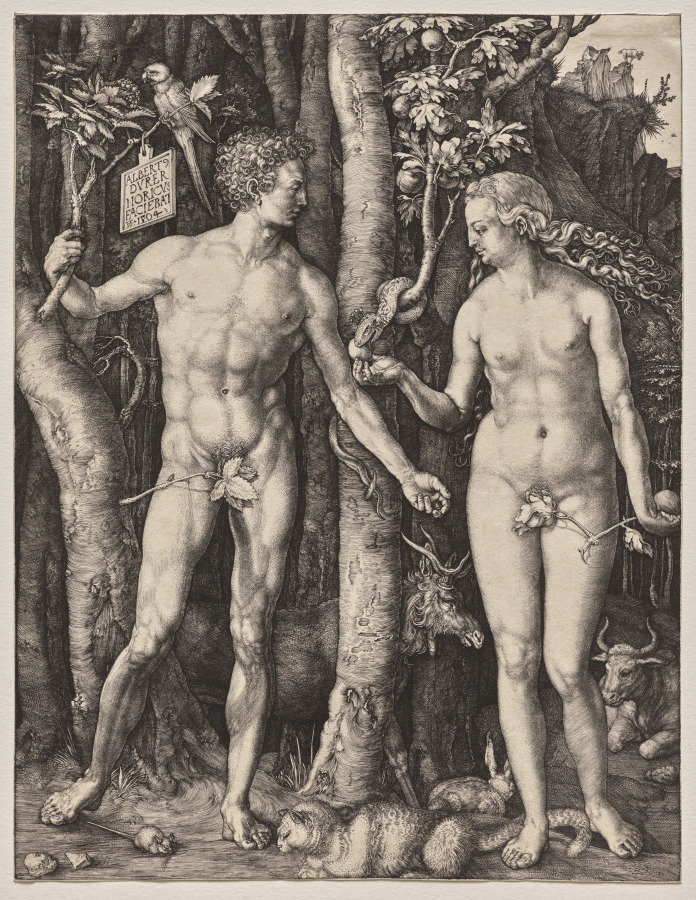
Adam and Eve (1504) is in the Cleveland Museum of Art collection. The museum's creator attribution is Albrecht Dürer (German, 1471–1528).
The work and its context
The museum's open-access catalogue describes the work:
Albrecht Dürer’s iconic engraving was hugely impactful to the spread of natural symbolism in Europe. Drawing upon classical sculptural models, he represented Adam and Eve in perfect, uncorrupted beauty moments before tasting the forbidden fruit. The tree of knowledge, with its writhing serpent, is a fig tree, and the tree of life, which Adam clasps, is a mountain ash, native to Northern Europe. The elk, rabbit, cat, and ox are symbols of the four human temperaments—melancholic (gloomy), sanguine (sensual), choleric (cruel), and phlegmatic (slothful)—in perfect balance. But the cat and mouse hint at aggression to come, and the parrot, appearing like a beacon in the dark northern forest, heralds the promise of the Virgin Mary (the new Eve).
Object facts
- Title: Adam and Eve
- Date: 1504
- Creator attribution: Albrecht Dürer (German, 1471–1528)
- Culture: Germany, early 16th Century
- Type: Print
- Technique: engraving
- Dimensions: Image: 25 x 19.2 cm (9 13/16 x 7 9/16 in.); Sheet: 25.2 x 19.4 cm (9 15/16 x 7 5/8 in.)
- Collection: PR - Engraving
- Department: Prints
- Accession number: 1944.473
A detail from the museum
Albrecht Dürer set the Garden of Eden in a northern forest, with the tree of knowledge represented by a fig tree and the tree of life by a mountain ash.
Collection credit
Dudley P. Allen Fund
Further reading listed by the museum
- Wehn, James. "Gods and Heroes: Ancient legends found new life in Renaissance art.” Cleveland Art: Cleveland Museum of Art Members Magazine 57, no. 5 (September/October 2017): 10-11.
View the collection record
See the museum's photographs and full catalogue entry. Catalogue text is reproduced from the Cleveland Museum of Art's open-access data, with HTML formatting removed. This object and its supplied image are designated CC0.
Sources
More in Lifestyle
Keep reading
Related stories