Adoring Attendant from a Buddhist Shrine (c. 300s–400s CE): Art, History and Details
Adoring Attendant from a Buddhist Shrine at the Cleveland Museum of Art: c. 300s–400s CE, stucco. Explore the work's context, creator attribution and collection history.
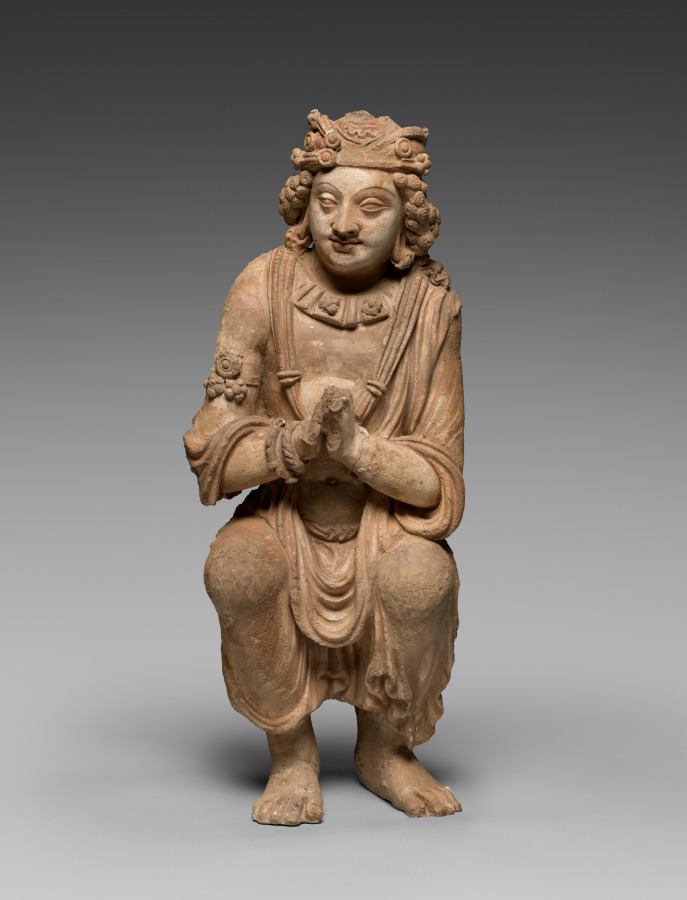
Adoring Attendant from a Buddhist Shrine (c. 300s–400s CE) is in the Cleveland Museum of Art collection.
The work and its context
The museum's open-access catalogue describes the work:
The medium of stucco became popular after the 4th century for works made for Buddhist sanctuaries, especially in the desert regions of Afghanistan where stone was less available. The more malleable material allowed sculptors to create sensitive and supplely modeled forms. The stucco sculptures were covered with a thin coat of lime-based whitewash, then painted; traces of original red pigment remain in some areas.
Object facts
- Title: Adoring Attendant from a Buddhist Shrine
- Date: c. 300s–400s CE
- Culture: Afghanistan, Gandhara, Kushan
- Type: Sculpture
- Technique: stucco
- Dimensions: Overall: 54.6 cm (21 1/2 in.)
- Collection: Indian Art - Kushan, Gandhara
- Department: Indian and Southeast Asian Art
- Accession number: 1943.395
Collection credit
Purchase from the J. H. Wade Fund
Further reading listed by the museum
- Lee, Sherman E. Buddhist Art. Detroit Institute of Arts, Twenty-Fourth Loan Exhibition, October, 1942. Detroit: Detroit Institute of Arts, 1942.
- Hollis, Howard. “Central Asian Stucco Sculptures.” The Bulletin of the Cleveland Museum of Art, vol. 32, no. 3, 1945, pp. 26–27.
- The Cleveland Museum of Art. The Cleveland Museum of Art Handbook. Cleveland, OH: The Cleveland Museum of Art, 1958.
View the collection record
See the museum's photographs and full catalogue entry. Catalogue text is reproduced from the Cleveland Museum of Art's open-access data, with HTML formatting removed. This object and its supplied image are designated CC0.
Sources
More in Lifestyle
Keep reading