Agni, God of Fire (c. 1000): Art, History and Details
Agni, God of Fire at the Cleveland Museum of Art: c. 1000, sandstone. Explore the work's context, creator attribution and collection history.
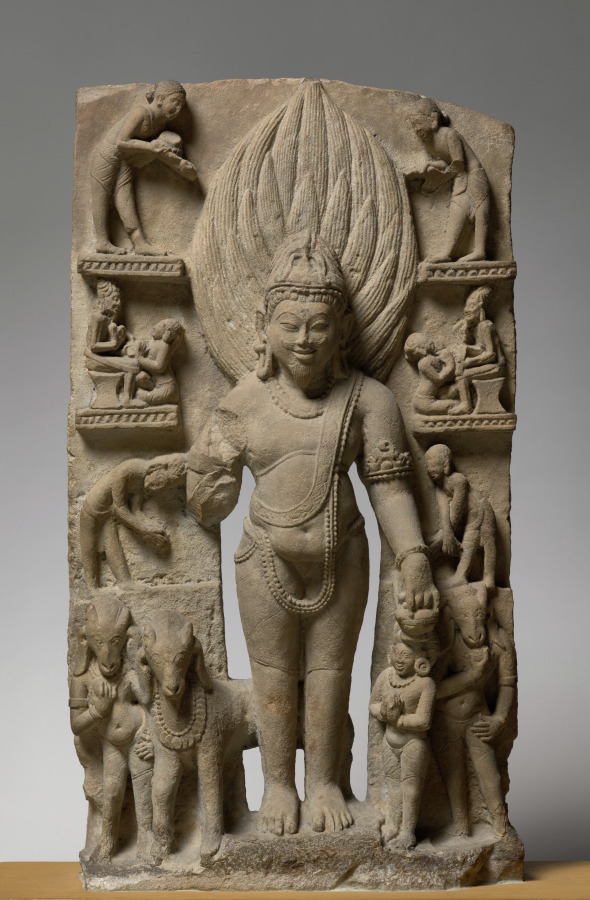
Agni, God of Fire (c. 1000) is in the Cleveland Museum of Art collection.
The work and its context
The museum's open-access catalogue describes the work:
The Hindu god Agni, with flames rising behind him, is the figural form of the sacrificial fire, central to religious practice in India since the early second millennium BC. Agni’s mount is the goat, and together they preside over the Southeast. In the upper registers, Brahmans perform fire sacrifice, preach to disciples, and practice "hot yoga."
Object facts
- Title: Agni, God of Fire
- Date: c. 1000
- Culture: India, Uttar Pradesh
- Type: Sculpture
- Technique: sandstone
- Dimensions: Overall: 73 x 40.6 cm (28 3/4 x 16 in.)
- Collection: Indian Art
- Department: Indian and Southeast Asian Art
- Accession number: 1955.51
A detail from the museum
This sculpture is on the cover of the Penguin Classics edition of the Hindu "Laws of Manu."
Collection credit
Edward L. Whittemore Fund
Further reading listed by the museum
- “Part II. Annual Report Issue for the Year 1955.” The Bulletin of the Cleveland Museum of Art, vol. 43, no. 6, 1956, pp. 131–167.
- Ward, William. "Agni, God of Fire." The Bulletin of the Cleveland Museum of Art 42, no. 9 (November 1955): 205–208.
- The Cleveland Museum of Art. The Cleveland Museum of Art Handbook. Cleveland, OH: The Cleveland Museum of Art, 1958.
View the collection record
See the museum's photographs and full catalogue entry. Catalogue text is reproduced from the Cleveland Museum of Art's open-access data, with HTML formatting removed. This object and its supplied image are designated CC0.
Sources
More in Lifestyle
Keep reading