Aizen Myōō (1300s): Art, History and Details
Aizen Myōō at the Cleveland Museum of Art: 1300s, Hanging scroll; ink, color, and gold on silk. Explore the work's context, creator attribution and collection history.
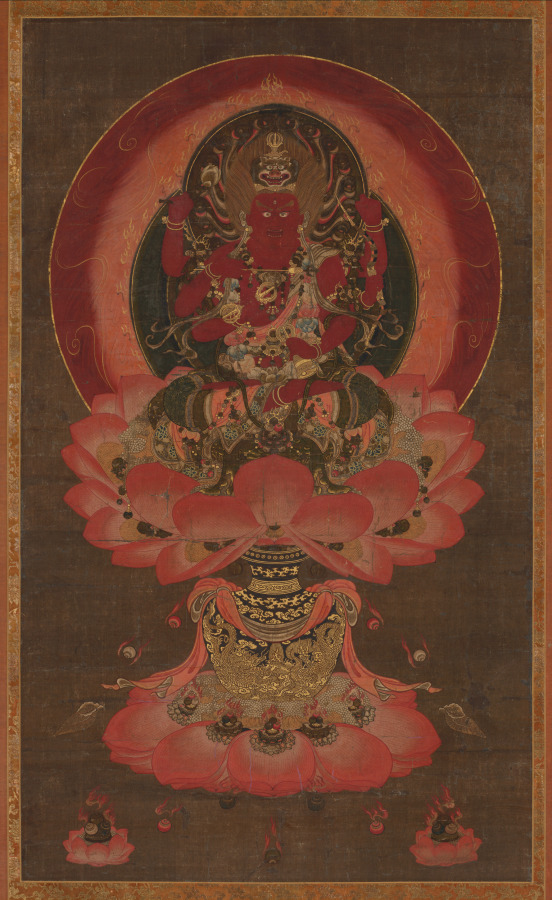
Aizen Myōō (1300s) is in the Cleveland Museum of Art collection.
The work and its context
The museum's open-access catalogue describes the work:
Aizen Myōō is the Wisdom King of Passion. He is one of the Five Great Wisdom Kings who protect the Five Wisdom Buddhas. Each of these Buddhas represents one of the five types of wisdom characterizing a mind purified of disturbing emotions, such as desire, fear, and anger. Aizen’s body is red, and he has six arms. He has a flaming mandorla, or body halo, and sits upon a lotus supported by a vase from which flaming, wish-fulfilling jewels flow freely.
Object facts
- Title: Aizen Myōō
- Date: 1300s
- Culture: Japan, Kamakura period (1185–1333) to Nanbokuchō period (1336–92)
- Type: Painting
- Technique: Hanging scroll; ink, color, and gold on silk
- Dimensions: Painting: 102 x 60.5 cm (40 3/16 x 23 13/16 in.); Mounted: 183.2 x 80.3 cm (72 1/8 x 31 5/8 in.)
- Collection: ASIAN - Hanging scroll
- Department: Japanese Art
- Accession number: 2017.101
A detail from the museum
Desires are mentally deposited into the mouth of Aizen's lion so that they can be consumed.
Collection credit
Purchase from the J. H. Wade Fund
Further reading listed by the museum
- Kanazawa Bunko 金沢文庫. Aizen Myōō: ai to ikari no hotoke: tokubetsu-ten Kōshō Bosatsu Eison Kamakura gekō nanahyaku gojū-nen kinen I 愛染明王 : 愛と怒りのほとけ. [S.I.]: Kanagawa Kenritsu Kanazawa Bunko, 2011.
- von Spee, Clarissa. “Acquisition Highlights: Asian Art.” Cleveland Art: Cleveland Museum of Art Members Magazine 58, no. 2 (March/April 2018): 10–11.
View the collection record
See the museum's photographs and full catalogue entry. Catalogue text is reproduced from the Cleveland Museum of Art's open-access data, with HTML formatting removed. This object and its supplied image are designated CC0.
Sources
More in Lifestyle
Keep reading