Akshobhya: the Buddha of the East (late 800s): Art, History and Details
Akshobhya: the Buddha of the East at the Cleveland Museum of Art: late 800s, bronze with silver and copper inlay. Explore the work's context, creator attribution and collection history.
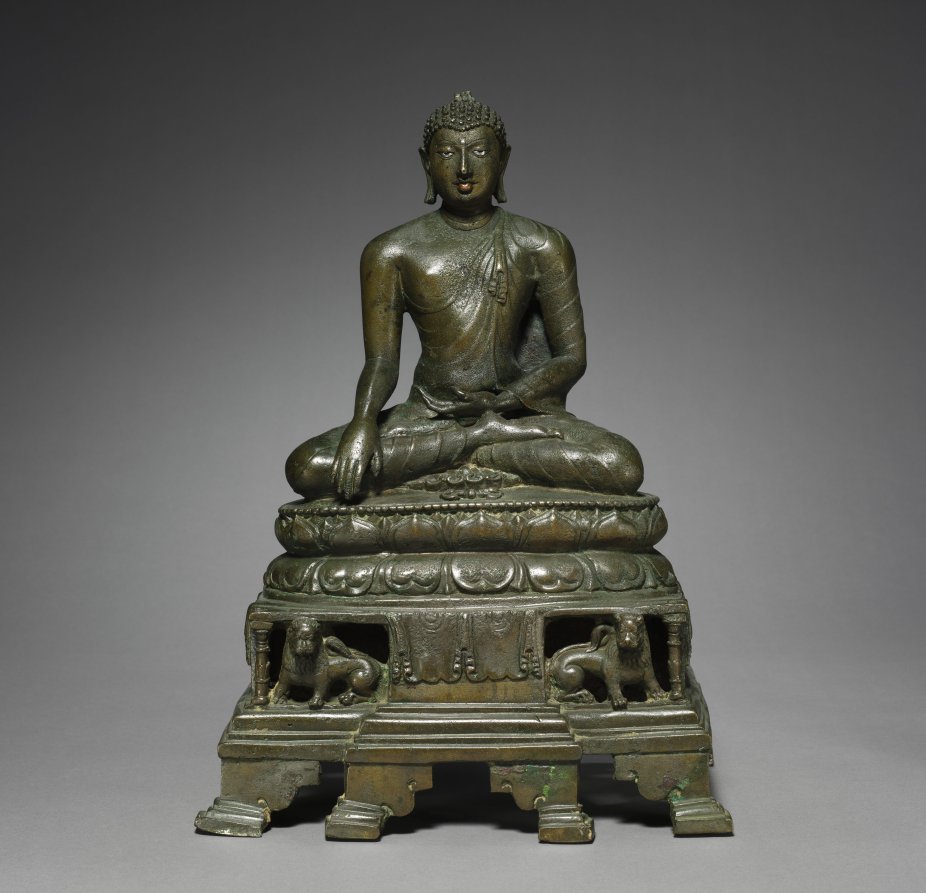
Akshobhya: the Buddha of the East (late 800s) is in the Cleveland Museum of Art collection.
The work and its context
The museum's open-access catalogue describes the work:
Made during the Pala period (750-1134) when tantric imagery was first emerging in northeastern India, this sculpture is from a cache that yielded some of the most masterful works of the north Indian bronze tradition. From this region, Tantra spread to Southeast Asia. The double-headed thunderbolt, or vajra, placed on top of the pedestal in front of the figure indicates that this is a tantric image. His hand gestures identify him as one of the Five Cosmic Buddhas, each of whom is associated with a cardinal direction of space: north, south, east, west, and center. The Buddha Akshobhya is especially invoked to eradicate the harmful emotion of anger.
Object facts
- Title: Akshobhya: the Buddha of the East
- Date: late 800s
- Culture: Northeast India, Bihar, Kurkihar, Pala period
- Type: Sculpture
- Technique: bronze with silver and copper inlay
- Dimensions: Overall: 38.8 x 26.3 cm (15 1/4 x 10 3/8 in.)
- Collection: Indian Art
- Department: Indian and Southeast Asian Art
- Accession number: 1970.10
Collection credit
Purchase from the J. H. Wade Fund
Further reading listed by the museum
- Sutton, D. “The New Oriental Galleries at Cleveland,” Apollo, Aug. 1970, Vol. 92, pp. 148-151.
- “Art of Asia Recently Acquired by American Museums, 1970.” Archives of Asian Art, vol. 25, 1971, pp. 91–120.
- Lee, Sherman E. “The Year in Review for 1970.” The Bulletin of the Cleveland Museum of Art, vol. 58, no. 2, 1971, pp. 22–71.
View the collection record
See the museum's photographs and full catalogue entry. Catalogue text is reproduced from the Cleveland Museum of Art's open-access data, with HTML formatting removed. This object and its supplied image are designated CC0.
Sources
More in Lifestyle
Keep reading