Alabastron (305–222 BCE): Art, History and Details
Alabastron at the Cleveland Museum of Art: 305–222 BCE, travertine. Explore the work's context, creator attribution and collection history.
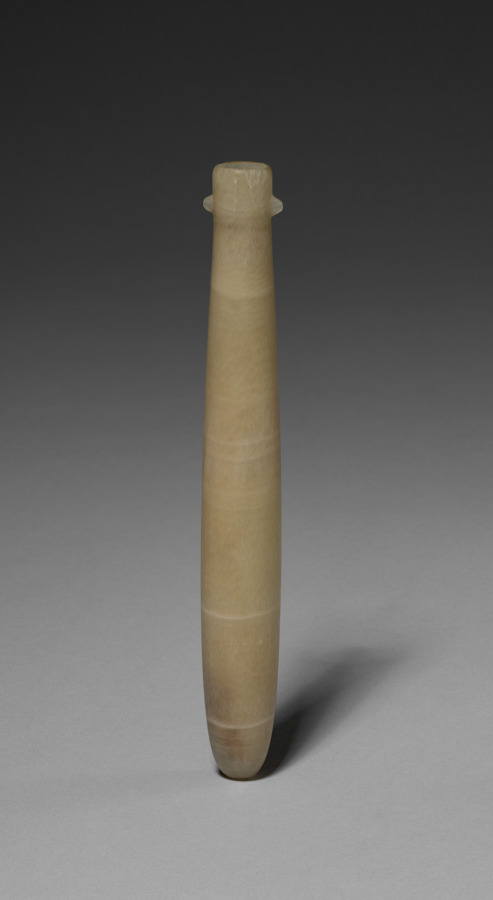
Alabastron (305–222 BCE) is in the Cleveland Museum of Art collection.
The work and its context
The museum's open-access catalogue describes the work:
Both ancient Egyptian men and women loved cosmetics. Unguents, oils, and perfumes made from aromatic plant resins and gums were obtained at great cost from distant lands. The objects identified with cosmetics were given lavish treatment.
Object facts
- Title: Alabastron
- Date: 305–222 BCE
- Culture: Egypt, Greco-Roman period (332 BCE–395 CE), Ptolemaic dynasty (305–30 BCE)
- Type: Vessels
- Technique: travertine
- Dimensions: Diameter: 3.3 cm (1 5/16 in.); Overall: 22.9 cm (9 in.); Stopper: 4.5 cm (1 3/4 in.); Body: 19.1 x 2.5 cm (7 1/2 x 1 in.)
- Collection: Egypt - Ptolemaic Dynasty
- Department: Egyptian and Ancient Near Eastern Art
- Accession number: 1995.262.a
A detail from the museum
This perfume holder might have been attached to a string, making it easily portable.
Collection credit
John L. Severance Fund
Further reading listed by the museum
- Berman, Lawrence M., and Kenneth J. Bohač. Catalogue of Egyptian Art: The Cleveland Museum of Art. Cleveland, OH: Cleveland Museum of Art, 1999.
View the collection record
See the museum's photographs and full catalogue entry. Catalogue text is reproduced from the Cleveland Museum of Art's open-access data, with HTML formatting removed. This object and its supplied image are designated CC0.
Sources
More in Lifestyle
Keep reading
Related stories
![Leaf from a Missal with Two Historiated Initials: Initial P[er omnia saecula saeculorum] (A Priest Celebrates Mass) and Initial V[ere dignum et iustum est] (Ecclesia and Synagogue) (c. 1300; Cleveland 1982.141)](https://openaccess-cdn.clevelandart.org/1982.141/1982.141_web.jpg)