Alexander the Great on Horseback (700s): Art, History and Details
Alexander the Great on Horseback at the Cleveland Museum of Art: 700s, dyed wool, undyed linen; plain weave and slit-tapestry weave. Explore the work's context, creator attribution and collection history.
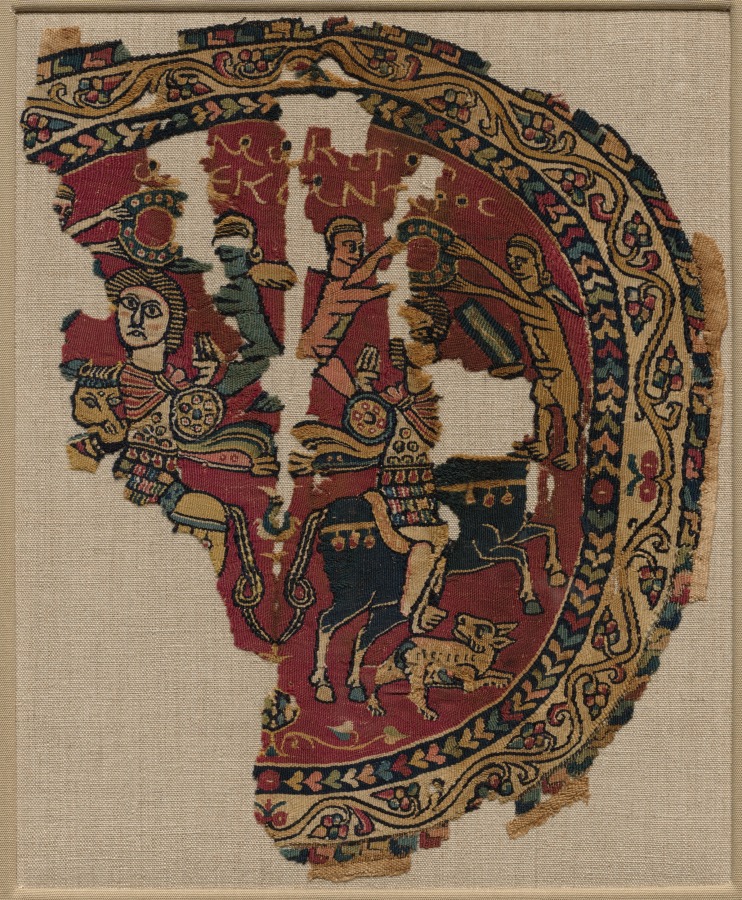
Alexander the Great on Horseback (700s) is in the Cleveland Museum of Art collection.
The work and its context
The museum's open-access catalogue describes the work:
Featuring imperial Byzantine themes, this rare roundel originally decorated a tunic. Genii (guardian spirits) crown the mounted horseman in military dress while an animal runs below. The inscription at the top identifies the horseman as Alexander the Great (356-323 bc), a popular cult figure in Egypt for centuries. The pattern’s mirror-image symmetry indicates the influence of costlier Byzantine silks.
Object facts
- Title: Alexander the Great on Horseback
- Date: 700s
- Culture: Egypt, Umayyad period (661–750) or Abbasid period (750–1258)
- Type: Textile
- Technique: dyed wool, undyed linen; plain weave and slit-tapestry weave
- Dimensions: Overall: 30.5 x 24.8 cm (12 x 9 3/4 in.); Mounted: 41.9 x 36.8 cm (16 1/2 x 14 1/2 in.)
- Collection: T - Coptic
- Department: Textiles
- Accession number: 1959.123
Collection credit
Gift of The Textile Arts Club
Further reading listed by the museum
- S. E. L. "Year in Review." The Bulletin of the Cleveland Museum of Art 46, no. 10 (1959): 210-31.
- Shepherd, Dorothy G. "Alexander: The Victorious Emperor." The Bulletin of the Cleveland Museum of Art 58, no. 8 (1971): 244-50.
- Wardwell, Anne E. Material Matters: Fifty Years of Gifts from the Textile Arts Club, 1934-1984 : [Exhibition] 21 November-30 December 1984, the Cleveland Museum of Art. Cleveland: The Museum, 1984.
View the collection record
See the museum's photographs and full catalogue entry. Catalogue text is reproduced from the Cleveland Museum of Art's open-access data, with HTML formatting removed. This object and its supplied image are designated CC0.
Sources
More in Lifestyle
Keep reading