Amida Buddha (581–618): Art, History and Details
Amida Buddha at the Cleveland Museum of Art: 581–618, limestone with traces of polychromy. Explore the work's context, creator attribution and collection history.
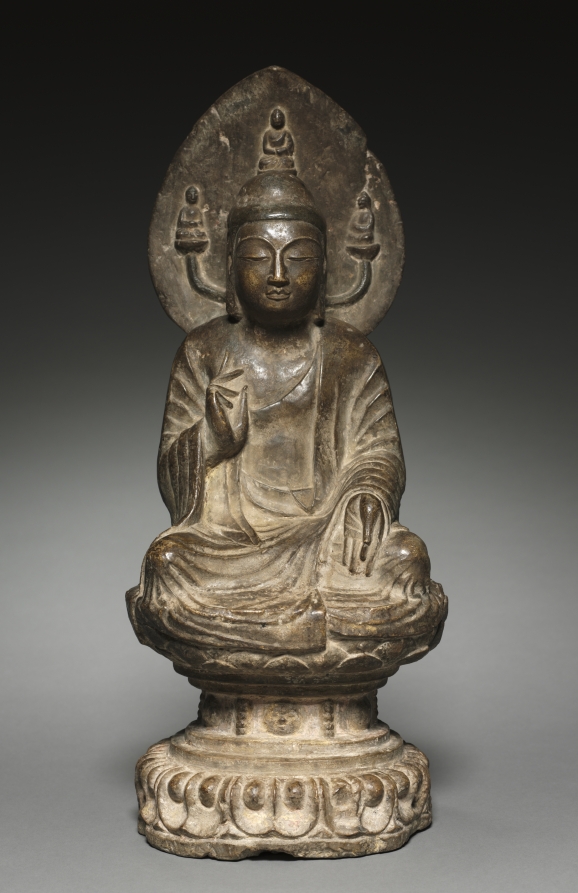
Amida Buddha (581–618) is in the Cleveland Museum of Art collection.
The work and its context
The museum's open-access catalogue describes the work:
The leaf-shaped halo of this seated Buddha bears the rare, unusual icon of the three nirmana Buddhas, which represents a symbolic homage of the Buddhas of the past, the present, and the future—manifestations of the Buddha in infinite time and space. Another interpretation is that the three figures without halos represent souls reborn in the Western Paradise thanks to Amida Buddha's divine intervention.
Object facts
- Title: Amida Buddha
- Date: 581–618
- Culture: China, Sui dynasty (581-618)
- Type: Sculpture
- Technique: limestone with traces of polychromy
- Dimensions: Overall: 51.4 x 20.3 cm (20 1/4 x 8 in.)
- Collection: China - Sui Dynasty
- Department: Chinese Art
- Accession number: 1964.152
Collection credit
John L. Severance Fund
Further reading listed by the museum
- The Cleveland Museum of Art. Handbook of the Cleveland Museum of Art/1966. Cleveland, OH: The Cleveland Museum of Art, 1966.
- Ho, Wai-Kam. “Three Seated Stone Buddhas.” The Bulletin of the Cleveland Museum of Art 53, no. 4 (April 1966): 84–102.
- The Cleveland Museum of Art. Handbook of the Cleveland Museum of Art/1969. Cleveland, OH: The Cleveland Museum of Art, 1969.
View the collection record
See the museum's photographs and full catalogue entry. Catalogue text is reproduced from the Cleveland Museum of Art's open-access data, with HTML formatting removed. This object and its supplied image are designated CC0.
Sources
More in Lifestyle
Keep reading