Amorous Couple (Mithuna) (400s): Art, History and Details
Amorous Couple (Mithuna) at the Cleveland Museum of Art: 400s, terracotta. Explore the work's context, creator attribution and collection history.
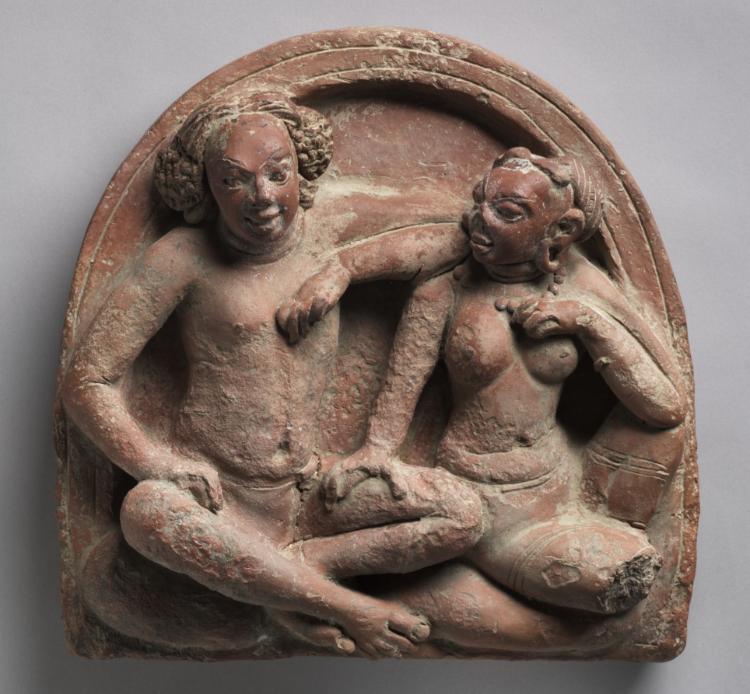
Amorous Couple (Mithuna) (400s) is in the Cleveland Museum of Art collection.
The work and its context
The museum's open-access catalogue describes the work:
Amorous couples were among the most prevalent imagery on the exterior of sacred sites in early India. Their life-affirming imagery was considered auspicious. This roundel would have been part of a brick structure, since terracotta was typically used in the ornamentation of brick temples, instead of stone.
Object facts
- Title: Amorous Couple (Mithuna)
- Date: 400s
- Culture: Northern India, Uttar Pradesh, Ahichchatra, Gupta period (c. 320-550)
- Type: Sculpture
- Technique: terracotta
- Dimensions: Overall: 38.5 x 37 cm (15 3/16 x 14 9/16 in.)
- Collection: Indian Art
- Department: Indian and Southeast Asian Art
- Accession number: 1971.133
A detail from the museum
The site of Ahichchatra retains ruins of a pyramid-shaped brick temple dedicated to Shiva.
Collection credit
Purchase from the J. H. Wade Fund
Further reading listed by the museum
- Lee, Sherman E. “The Year in Review for 1971.” The Bulletin of the Cleveland Museum of Art 59, no. 1 (January 1972): 3–46.
- Pal, Pratapaditya. The Ideal Image: The Gupta Sculptural Tradition and Its Influence. New York: Asia Society in association with J. Weatherhill, 1978.
- Neils, Jenifer. The World of Ceramics: Masterpieces from the Cleveland Museum of Art. Cleveland, OH: The Museum in cooperation with Indiana University Press, 1982.
View the collection record
See the museum's photographs and full catalogue entry. Catalogue text is reproduced from the Cleveland Museum of Art's open-access data, with HTML formatting removed. This object and its supplied image are designated CC0.
Sources
More in Lifestyle
Keep reading