An Episode from the Story of the Sasanian King Khusrau and His Beloved Shirin, from a Khamsa (Quintet) of Nizami (1141–1209) (verso); Persian verses from a Haft Awrang (Seven Thrones) of Jami (d. 1492
An Episode from the Story of the Sasanian King Khusrau and His Beloved Shirin, from a Khamsa (Quintet) of Nizami (1141–1209) (verso); Persian verses from a Haft Awrang (Seven Thrones) of Jami (d. 1492) (recto) at the Cleveland Museum of Art
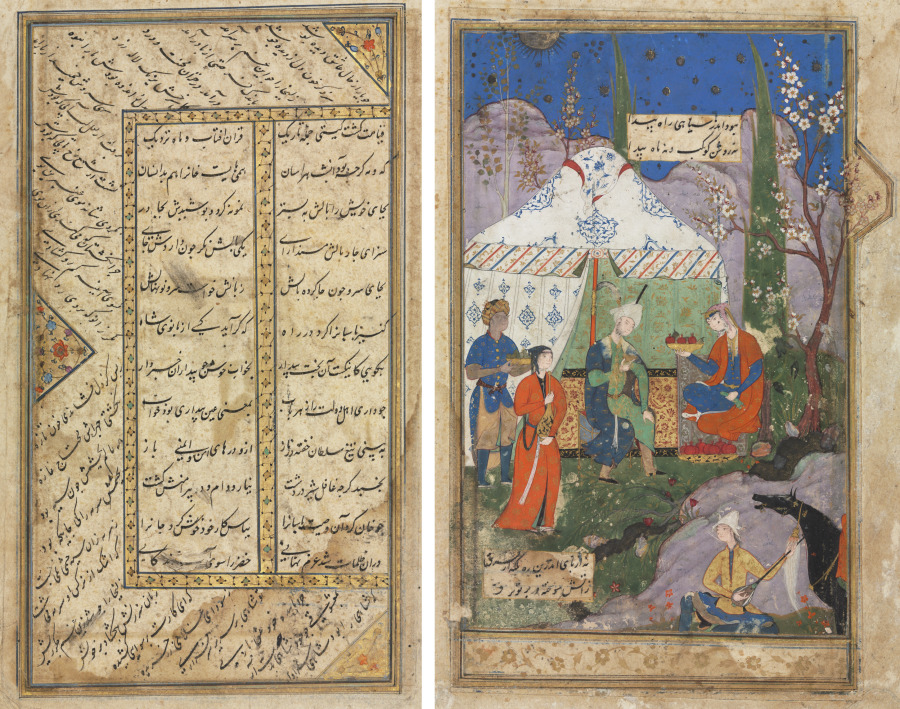
An Episode from the Story of the Sasanian King Khusrau and His Beloved Shirin, from a Khamsa (Quintet) of Nizami (1141–1209) (verso); Persian verses from a Haft Awrang (Seven Thrones) of Jami (d. 1492) (recto) (1540–70) is in the Cleveland Museum of Art collection.
The work and its context
The museum's open-access catalogue describes the work:
The Khamsa is a collection of five narrative poems, one of which is dedicated to the romance of Khusrau Parviz (590–628), a Sasanian king of Iran, and Shirin, his beloved Armenian princess. The lovers are seated in a nocturnal landscape, indicated by the dark blue sky dotted with stars, painted with now tarnished silver. Shirin serves figs and pomegranates, symbolic of fertility, to Khusrau as attendants bring more figs and wine. Next to Shirin’s black horse, the musician at bottom right plays a tanbur, a long-necked, fretted lute.
Object facts
- Title: An Episode from the Story of the Sasanian King Khusrau and His Beloved Shirin, from a Khamsa (Quintet) of Nizami (1141–1209) (verso); Persian verses from a Haft Awrang (Seven Thrones) of Jami (d. 1492) (recto)
- Date: 1540–70
- Culture: Iran, probably Shiraz, Safavid period (1501-1722)
- Type: Manuscript
- Technique: opaque watercolor, gold, silver, and ink on paper; double-sided
- Dimensions: Sheet: 29.6 x 16.2 cm (11 5/8 x 6 3/8 in.); Image: 21 x 13 cm (8 1/4 x 5 1/8 in.)
- Collection: Islamic Art
- Department: Islamic Art
- Accession number: 1947.500
A detail from the museum
Khusrau’s turban has the anachronistic baton worn by Safavid royalty and the egret feather, an emblem of nobility instituted by the Mongols in the 1200s.
Collection credit
Purchase from the J. H. Wade Fund
Further reading listed by the museum
- The Cleveland Museum of Art. The Cleveland Museum of Art Handbook. Cleveland, OH: The Cleveland Museum of Art, 1958.
- Wyche, Lois. “A Sixteenth-Century Persian Carpet.” The Bulletin of the Cleveland Museum of Art 50, no. 2 (February 1963): 35–39.
- The Cleveland Museum of Art. Handbook of the Cleveland Museum of Art/1966. Cleveland, OH: The Cleveland Museum of Art, 1966.
View the collection record
See the museum's photographs and full catalogue entry. Catalogue text is reproduced from the Cleveland Museum of Art's open-access data, with HTML formatting removed. This object and its supplied image are designated CC0.
Sources
- An Episode from the Story of the Sasanian King Khusrau and His Beloved Shirin, from a Khamsa (Quintet) of Nizami (1141–1209) (verso); Persian verses from a Haft Awrang (Seven Thrones) of Jami (d. 1492) (recto) (1540–70; Cleveland 1947.500) — Cleveland Museum of Art
- Cleveland Museum of Art Open Access
More in Lifestyle
Keep reading