Anahita Vessel (300–500 CE): Art, History and Details
Anahita Vessel at the Cleveland Museum of Art: 300–500 CE, silver, cast, raised, repoussé, chased, and gilted. Explore the work's context, creator attribution and collection history.
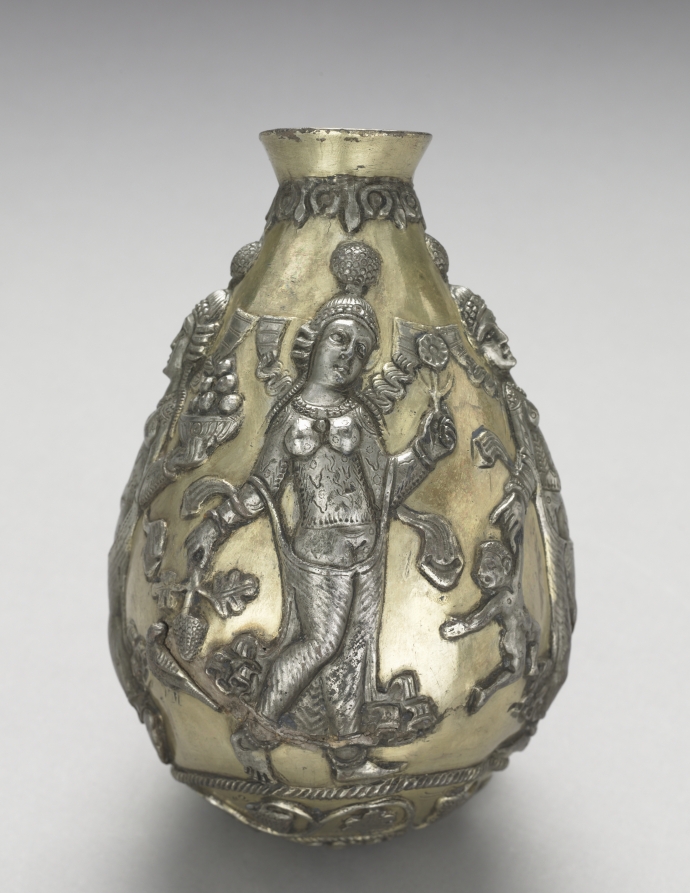
Anahita Vessel (300–500 CE) is in the Cleveland Museum of Art collection.
The work and its context
The museum's open-access catalogue describes the work:
These dancers may be sacred images of the Zoroastrian religion of the Sasanians or they may be bacchantes, followers of a cult of the Roman wine god, Bacchus, who was popular in the Near East.
Object facts
- Title: Anahita Vessel
- Date: 300–500 CE
- Culture: Iran, Sasanian Empire (224–651 CE)
- Type: Metalwork
- Technique: silver, cast, raised, repoussé, chased, and gilted
- Dimensions: Overall: 18.5 x 11.5 cm (7 5/16 x 4 1/2 in.)
- Collection: Near Eastern Art
- Department: Egyptian and Ancient Near Eastern Art
- Accession number: 1962.294
Collection credit
Gift of Katharine Holden Thayer
Further reading listed by the museum
- Lee, Sherman E. “Year in Review for 1963.” The Bulletin of the Cleveland Museum of Art, vol. 50, no. 10 (December 1963): 263–294.
- Shepherd, Dorothy G. “Sasanian Art in Cleveland.” The Bulletin of the Cleveland Museum of Art, vol. 51, no. 4, 1964, pp. 66–92.
- Harper, Prudence Oliver. "The Heavenly Twins." The Metropolitan Museum of Art Bulletin 23, no. 5 (January 1965): 186-196.
View the collection record
See the museum's photographs and full catalogue entry. Catalogue text is reproduced from the Cleveland Museum of Art's open-access data, with HTML formatting removed. This object and its supplied image are designated CC0.
Sources
More in Lifestyle
Keep reading