Ancestral Altar Tusk (c. 1820): Art, History and Details
Ancestral Altar Tusk at the Cleveland Museum of Art: c. 1820, Elephant ivory. Explore the work's context, creator attribution and collection history.
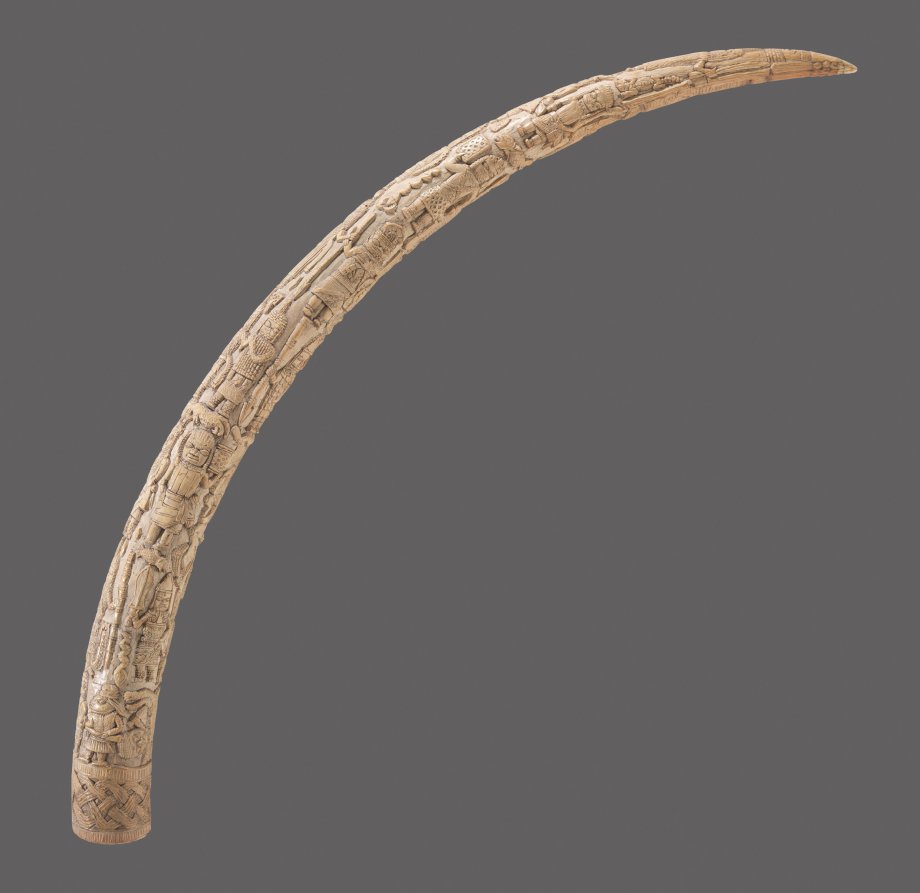
Ancestral Altar Tusk (c. 1820) is in the Cleveland Museum of Art collection.
The work and its context
The museum's open-access catalogue describes the work:
Ọba Ọsẹmwẹdẹ commissioned the carving of this tusk to connect with his ancestors and symbolize his strength. It is covered with royal figures wearing elaborate regalia and scenes of power, ritual, and violence. While Benin royal symbols may look similar across centuries, their meanings can shift. Ọsẹmwẹdẹ’s reign was prosperous due to trade with the Dutch; however, 16th-century Portuguese men are carved on the lower tusk. By the 1800s they represented any European traders. This tusk’s surface likely became worn and cracked from frequent washing, bleaching, and the applying of a white clay (orhue) linked to peace, purity, and prosperity.
Object facts
- Title: Ancestral Altar Tusk
- Date: c. 1820
- Culture: Nigeria, Benin Kingdom, Ẹdo peoples, members of the Igbesanmwan (wood and ivory carvers) guild
- Type: Sculpture
- Technique: Elephant ivory
- Dimensions: Overall: 197.4 cm (77 11/16 in.)
- Collection: African Art
- Department: African Art
- Accession number: 1968.284
A detail from the museum
Originally, this carved tusk was placed on an ancestral altar as part of an ensemble of objects made to memorialize a deceased Ọba (ruler).
Collection credit
Gift of Katherine C. White
Further reading listed by the museum
- Fricke, Berthold, ed. The Cleveland Museum of Art. Ahrbeck/Hannover: Knorr & Hirth Verlag GmbH, 1975, p. 102.
- Drewal, Henry John. African Art: A Brief Guide to the Collection. Cleveland: Cleveland Museum of Art, 1989, fig.6.
- Judith Perani and Fred T. Smith, The Visual Arts of Africa: Gender, Power, and Life Cycle Rituals, (Prentice Hall, NJ, 1998), fig. 6.7, pp. 175-176.
View the collection record
See the museum's photographs and full catalogue entry. Catalogue text is reproduced from the Cleveland Museum of Art's open-access data, with HTML formatting removed. This object and its supplied image are designated CC0.
Sources
More in Lifestyle
Keep reading
![The Park at Sceaux [April 1925, 7a.m.] (1925; Cleveland 2002.68)](https://openaccess-cdn.clevelandart.org/2002.68/2002.68_web.jpg)