Apollo and the Serpent Python (from Set of Ovid's Metamorphoses) (1700–1730): Art, History and Details
Apollo and the Serpent Python (from Set of Ovid's Metamorphoses) at the Cleveland Museum of Art: 1700–1730, tapestry weave. Explore the work's context, creator attribution and collection history.
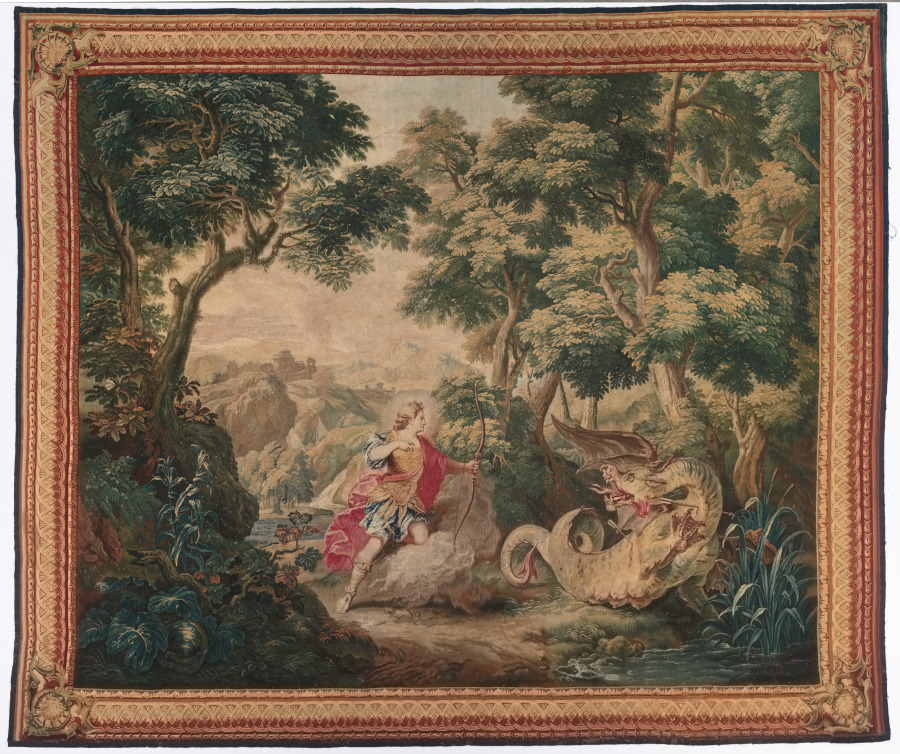
Apollo and the Serpent Python (from Set of Ovid's Metamorphoses) (1700–1730) is in the Cleveland Museum of Art collection. The museum's creator attribution is Gobelins Manufactory (France, Paris, est. 1662); Nicolas Bertin (French, 1668–1736).
The work and its context
The museum's open-access catalogue describes the work:
Apollo’s dynamic posture with his right arm pulled back and his left holding a bow indicates that he has just shot the arrow piercing the snarling serpent’s throat and body. Apollo’s triumph over powerful Python, the fearsome serpent offspring of Mother Earth or Gaia, boosted his ego tremendously, leading to his tragically unsuccessful pursuit of Daphne. The regally dressed hunter and his prey are seen alone in an environment teeming with natural life that includes a pumpkin patch. In the creation of this textile, the manufacturer used blue and yellow dye to create the color green which has since degraded, causing the pumpkins and their leaves to appear blue.
Object facts
- Title: Apollo and the Serpent Python (from Set of Ovid's Metamorphoses)
- Date: 1700–1730
- Creator attribution: Gobelins Manufactory (France, Paris, est. 1662); Nicolas Bertin (French, 1668–1736)
- Culture: France
- Type: Tapestry
- Technique: tapestry weave
- Dimensions: Overall: 328 x 393 cm (129 1/8 x 154 3/4 in.)
- Collection: Textiles
- Department: Textiles
- Accession number: 1956.325.3
A detail from the museum
During the French Revolution, Gobelins tapestries were sometimes disassembled to harvest the gold threads.
Collection credit
Gift of Mrs. Matthias Plum
Further reading listed by the museum
- Malloy, Katherine R. “Three Eighteenth-Century Gobelins Tapestries.” The Bulletin of the Cleveland Museum of Art 44, no. 2 (1957): 24–27.
- Standen, Edith A. “Ovid’s ‘Metamorphoses’: A Gobelins Tapestry Series.” Metropolitan Museum Journal 23 (1988): 149–191.
View the collection record
See the museum's photographs and full catalogue entry. Catalogue text is reproduced from the Cleveland Museum of Art's open-access data, with HTML formatting removed. This object and its supplied image are designated CC0.
Sources
More in Lifestyle
Keep reading