Apollo Belvedere (1592): Art, History and Details
Apollo Belvedere at the Cleveland Museum of Art: 1592, engraving. Explore the work's context, creator attribution and collection history.
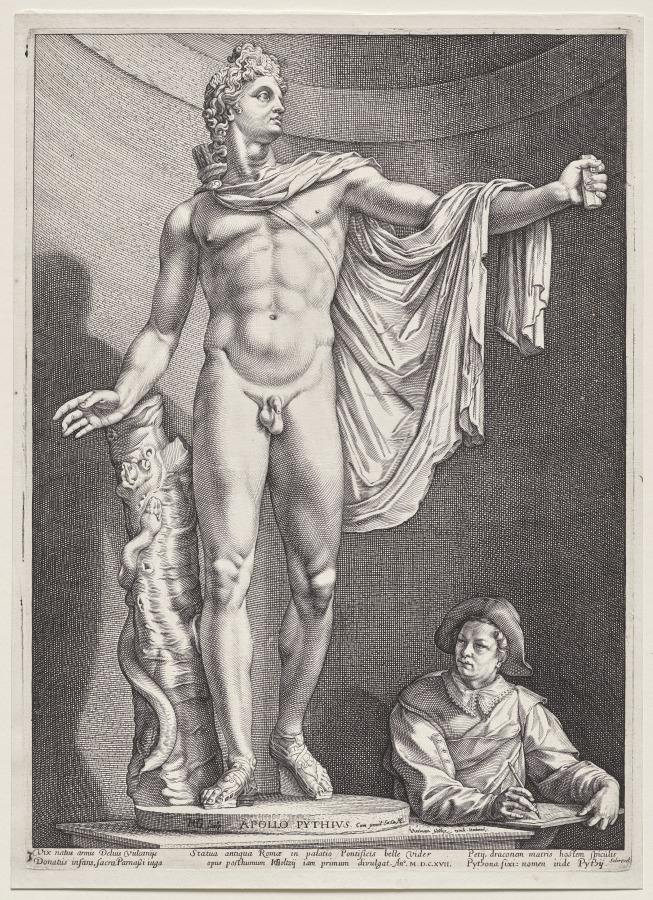
Apollo Belvedere (1592) is in the Cleveland Museum of Art collection. The museum's creator attribution is Hendrick Goltzius (Dutch, 1558–1617).
The work and its context
The museum's open-access catalogue describes the work:
Hendrick Goltzius was one of many late Renaissance artists who felt compelled to travel to Italy as part of his artistic training. He went with one purpose—to study antique sculpture. Goltzius made drawings on-site and then made engravings after his designs once he returned to Haarlem in 1591. He portrayed the Apollo Belvedere from a low viewpoint to capture the awesome experience of first encountering the famous monument. A seated, sketching artist emphasizes the experience of visiting, seeing, and drawing the sculpture in situ. The engraving shows to excellent advantage the virtuosic technique that Goltzius developed, in which the swelling and tapering line exaggerates the heroic musculature of the figure.
Object facts
- Title: Apollo Belvedere
- Date: 1592
- Creator attribution: Hendrick Goltzius (Dutch, 1558–1617)
- Culture: Netherlands, 16th century
- Type: Print
- Technique: engraving
- Dimensions: Platemark: 41.8 x 30.1 cm (16 7/16 x 11 7/8 in.); Sheet: 43.5 x 31.3 cm (17 1/8 x 12 5/16 in.)
- Collection: PR - Engraving
- Department: Prints
- Accession number: 2022.139
A detail from the museum
The 2nd-century Apollo Belvedere was unearthed in central Italy during the Renaissance and was on display at the Vatican Palace by the time Hendrick Goltzius visited the city.
Collection credit
Severance and Greta Millikin Purchase Fund
Further reading listed by the museum
- Goltzius, Hendrik, and Walter L. Strauss. Hendrik Goltzius, 1558-1617: The Complete Engravings and Woodcuts. New York: Abaris Books, 1977.
View the collection record
See the museum's photographs and full catalogue entry. Catalogue text is reproduced from the Cleveland Museum of Art's open-access data, with HTML formatting removed. This object and its supplied image are designated CC0.
Sources
More in Lifestyle
Keep reading