Apricot Long Shawl (1785–1800): Art, History and Details
Apricot Long Shawl at the Cleveland Museum of Art: 1785–1800, 2/2 twill tapestry weave, double interlocked; wool. Explore the work's context, creator attribution and collection history.
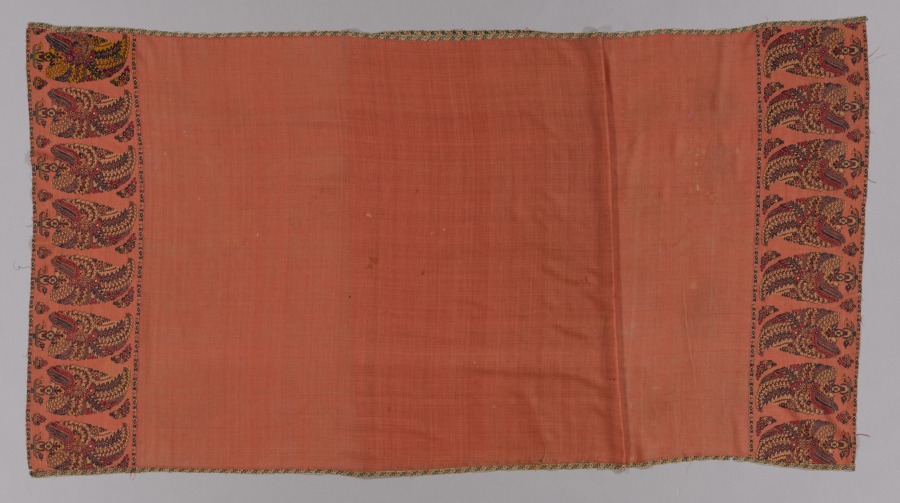
Apricot Long Shawl (1785–1800) is in the Cleveland Museum of Art collection.
The work and its context
The museum's open-access catalogue describes the work:
Artistic styles evolved with increasingly elaborate mosaic-like decoration during the 1800s to meet an insatiable European demand. Early shawls had plain fields with isolated plants in the end panels, which led to decorated side borders and vases of blossoming stems. Such flora was replaced by colorful, dense blossoms forming cone-shaped botehs, or paisleys, on trays. To this was added a gallery of small botehs and angular floral vines around a rich blue field with single botehs in the corners. Lightweight, supple, warm, and colorful, Kashmir shawls had no equal. Fine, soft goat-hair wool was woven in a 2/2 twill tapestry weave—the equivalent of painting with colored weft threads. Imitations woven in Paisley, Scotland, prompted the popular term paisley.
Object facts
- Title: Apricot Long Shawl
- Date: 1785–1800
- Culture: India, Kashmir, Afghan period
- Type: Textile
- Technique: 2/2 twill tapestry weave, double interlocked; wool
- Dimensions: Overall: 325 x 104.1 cm (127 15/16 x 41 in.)
- Collection: Textiles
- Department: Textiles
- Accession number: 2008.215
Collection credit
Gift of Arlene C. Cooper
View the collection record
See the museum's photographs and full catalogue entry. Catalogue text is reproduced from the Cleveland Museum of Art's open-access data, with HTML formatting removed. This object and its supplied image are designated CC0.
Sources
More in Lifestyle
Keep reading