Arm Bones (early 1540s): Art, History and Details
Arm Bones at the Cleveland Museum of Art: early 1540s, pen and brown ink with incised lines. Explore the work's context, creator attribution and collection history.
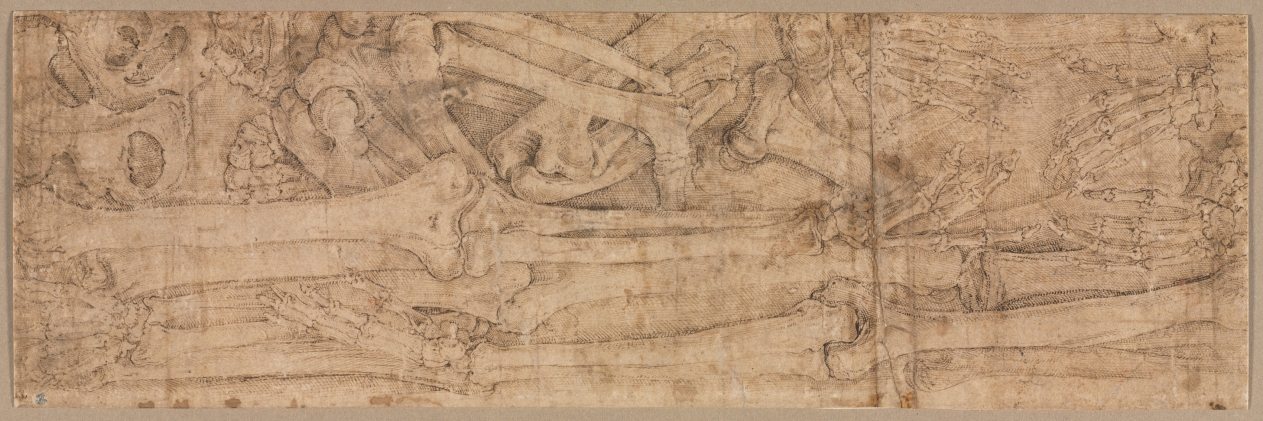
Arm Bones (early 1540s) is in the Cleveland Museum of Art collection. The museum's creator attribution is Battista Franco (Italian, c. 1510–1561).
The work and its context
The museum's open-access catalogue describes the work:
Michelangelo was among the first artists in Europe to attend a human dissection and to adopt anatomical knowledge as a necessity for depicting the human figure. These drawings by Battista Franco reflect the increased—and slightly macabre—interest in the interior workings of the human body inspired in part by Michelangelo’s example. Here, the groupings of arm bones, though rendered accurately, are placed into decorative piles. The odd assembly vacillates between scientific study and a symbolic memento mori, or reminder of death.
Object facts
- Title: Arm Bones
- Date: early 1540s
- Creator attribution: Battista Franco (Italian, c. 1510–1561)
- Culture: Italy
- Type: Drawing
- Technique: pen and brown ink with incised lines
- Dimensions: Sheet: 11.8 x 36.7 cm (4 5/8 x 14 7/16 in.); Secondary Support: 11.8 x 36.7 cm (4 5/8 x 14 7/16 in.)
- Collection: DR - Italian
- Department: Drawings
- Accession number: 1964.379
Collection credit
Gift of Mr. and Mrs. Claude Cassirer
Further reading listed by the museum
- Richards, Louise S. “Drawings by Battista Franco.” The Bulletin of the Cleveland Museum of Art 52, no. 8 (October 1965): 106–112.
- Kornell, Monique. “Anatomical Drawings by Battista Franco.” The Bulletin of the Cleveland Museum of Art 76, no. 9 (November 1989): 302–325.
View the collection record
See the museum's photographs and full catalogue entry. Catalogue text is reproduced from the Cleveland Museum of Art's open-access data, with HTML formatting removed. This object and its supplied image are designated CC0.
Sources
More in Lifestyle
Keep reading