Autumn: Vintage Scene (designed c. 1535, woven mid- to late 1600s): Art, History and Details
Autumn: Vintage Scene at the Cleveland Museum of Art: designed c. 1535, woven mid- to late 1600s, Wool, silk, and gold filé: tapestry weave. Explore the work's context, creator attribution and collection history.
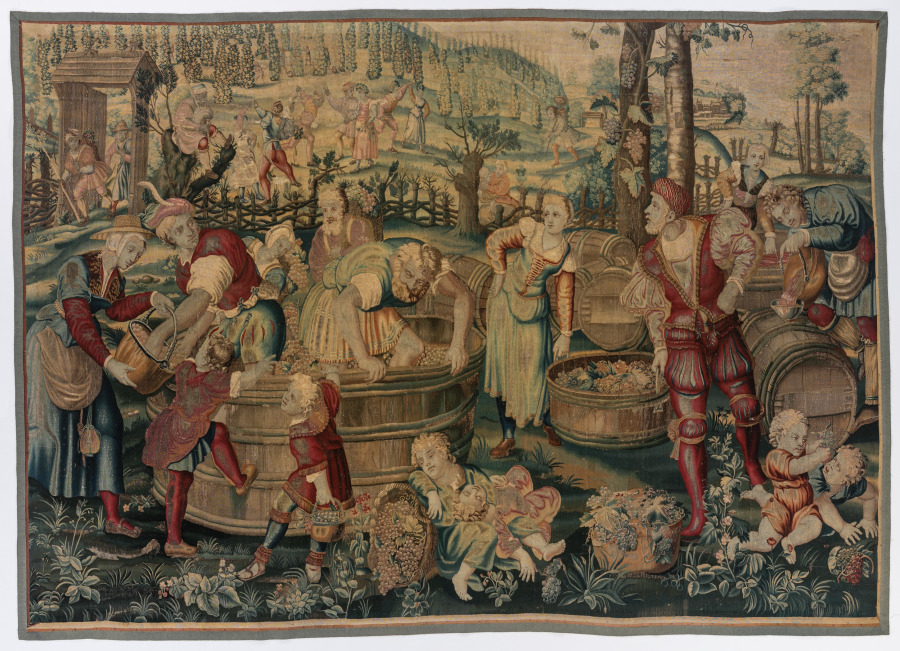
Autumn: Vintage Scene (designed c. 1535, woven mid- to late 1600s) is in the Cleveland Museum of Art collection. The museum's creator attribution is Gobelins Manufactory (France, Paris, est. 1662).
The work and its context
The museum's open-access catalogue describes the work:
In 16th-century Europe, the grape harvest took place in autumn, a tradition that persists among vintners to this day. Here, men and women gather grapes in buckets and drop them into an enormous wood vat. Two men stomp on the ripe grapes, squeezing out the juice. A man on the far right pours the juice into barrels, where it will ferment into wine. Children sleep or play in the foreground; one mischievous toddler presses grape juice into the mouth of another small child. In the distance four couples dance to music provided by a bagpiper, who is perched in a tree.
Object facts
- Title: Autumn: Vintage Scene
- Date: designed c. 1535, woven mid- to late 1600s
- Creator attribution: Gobelins Manufactory (France, Paris, est. 1662)
- Culture: France
- Type: Tapestry
- Technique: Wool, silk, and gold filé: tapestry weave
- Dimensions: Overall: 263 x 370 cm (103 9/16 x 145 11/16 in.)
- Collection: Textiles
- Department: Textiles
- Accession number: 1952.544.3
A detail from the museum
Originally green, the plants were woven using yarn first dyed blue and then dyed yellow; over time the yellow dye has faded so that today the plants appear blue.
Collection credit
Gift of Francis Ginn, Marian Ginn Jones, Barbara Ginn Griesinger, and Alexander Ginn in memory of Frank Hadley Ginn and Cornelia Root Ginn
Further reading listed by the museum
- Scaturro, Jane and Hanson, Robin. “Cycles of Life: Celebrating the four seasons.” Cleveland Art: Cleveland Museum of Art Members Magazine 62, no. 1: 18-21.
- Warwick House, Ltd, and Lucas. The Balloch Castle Seasons of Lucas; Being Four Gobelin Tapestries Rich with Gold, 8 Feet 2 Inches High, with Combined Width of 41 Feet 7 Inches, from Balloch Castle, Near Glasgow, Where They Hung for Nearly Two Centuries; a Companion Set to the Famous Months of Lucas, and by the Same Designer. Baltimore: N.T.A. Munder & Co., printers, 1918.
- Hunter, George Leland. "The Loan Exhibition of Tapestries." The Bulletin of the Cleveland Museum of Art 5, no. 8/9 (October-November 1918): 63-87.
View the collection record
See the museum's photographs and full catalogue entry. Catalogue text is reproduced from the Cleveland Museum of Art's open-access data, with HTML formatting removed. This object and its supplied image are designated CC0.
Sources
More in Lifestyle
Keep reading