Bacchanal with Silenus (late 1400s–early 1500s): Art, History and Details
Bacchanal with Silenus at the Cleveland Museum of Art: late 1400s–early 1500s, engraving. Explore the work's context, creator attribution and collection history.
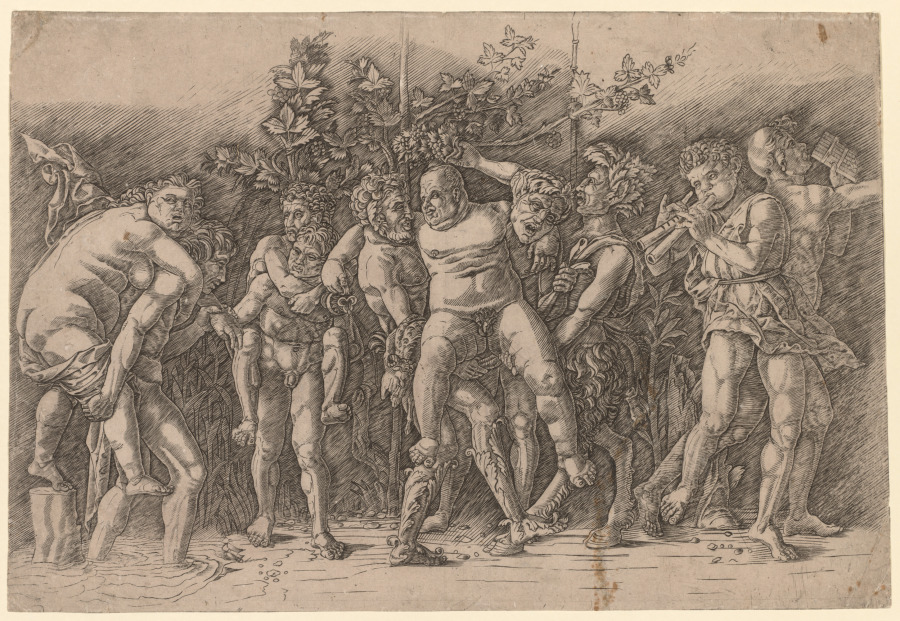
Bacchanal with Silenus (late 1400s–early 1500s) is in the Cleveland Museum of Art collection. The museum's creator attribution is Giovanni Antonio da Brescia (Italian); Andrea Mantegna (Italian, about 1431–1506).
The work and its context
The museum's open-access catalogue describes the work:
Perhaps unhappy with the way his engraved plates had worn down from use, Andrea Mantegna commissioned Giovanni Antonio da Brescia to reengrave several of his compositions. Comparing Da Brescia’s impression to Mantegna’s shows that the copperplate was less worn when the later print was made and the inks more expertly mixed to adhere to the incised lines, resulting in an overall stronger impression with greater contrast. The impact is a work that has a strong affinity with the relief-carved Roman sarcophagi (stone coffins) that inspired Mantegna.
Object facts
- Title: Bacchanal with Silenus
- Date: late 1400s–early 1500s
- Creator attribution: Giovanni Antonio da Brescia (Italian); Andrea Mantegna (Italian, about 1431–1506)
- Culture: Italy
- Type: Print
- Technique: engraving
- Dimensions: Sheet: 30.1 x 44.3 cm (11 7/8 x 17 7/16 in.)
- Collection: PR - Engraving
- Department: Prints
- Accession number: 1924.515
Collection credit
Gift of The Print Club of Cleveland
Further reading listed by the museum
- Prasse, Leona. "The Engraving of Andrea Mantegna." The Bulletin of the Cleveland Museum of Art 43, no. 4 (April 1956): 59-62.
View the collection record
See the museum's photographs and full catalogue entry. Catalogue text is reproduced from the Cleveland Museum of Art's open-access data, with HTML formatting removed. This object and its supplied image are designated CC0.
Sources
More in Lifestyle
Keep reading