Bacchanalian Scene (1–100 CE): Art, History and Details
Bacchanalian Scene at the Cleveland Museum of Art: 1–100 CE, schist. Explore the work's context, creator attribution and collection history.
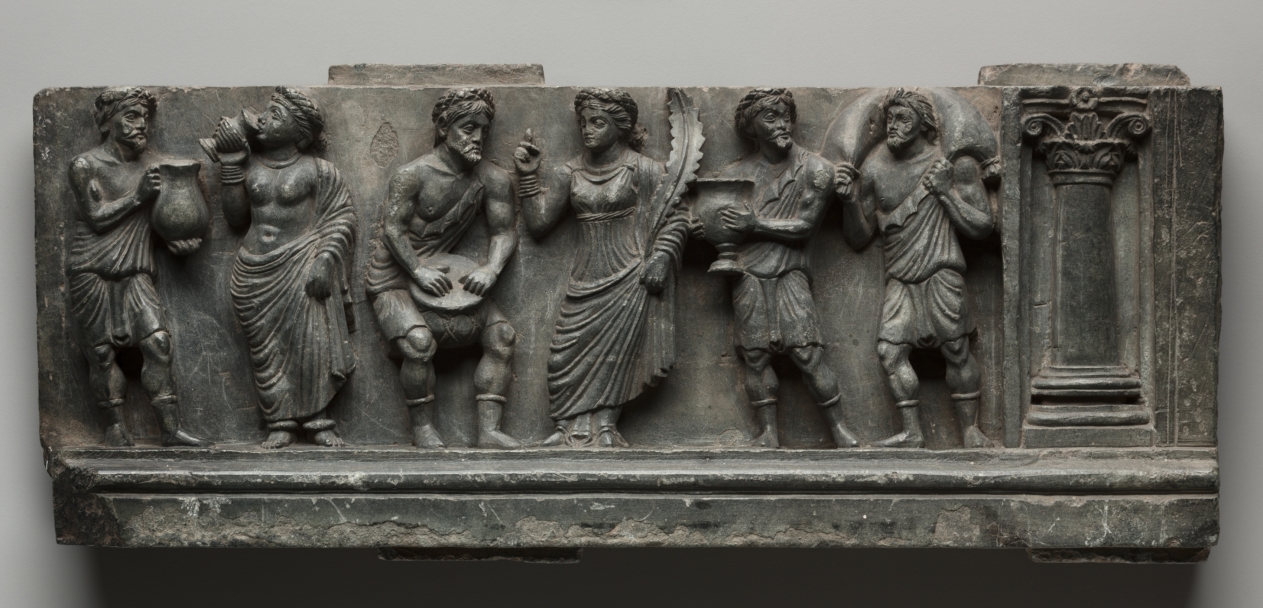
Bacchanalian Scene (1–100 CE) is in the Cleveland Museum of Art collection.
The work and its context
The museum's open-access catalogue describes the work:
The pleated garments and crowns of laurels suggest that these six figures were intended to appear like Greco-Roman people from the Mediterranean world. The male figure at the far right carries a skin, presumably full of wine, next to another bearded man holding a large footed vessel. A woman with a palm leaf on her arm—a sign of victory—gestures suggestively toward a man playing a drum. At the far left a figure drinks wine from a cup that the man at the far left may have just filled from his pitcher.
Object facts
- Title: Bacchanalian Scene
- Date: 1–100 CE
- Culture: Pakistan, Gandhara, Buner area, early Kushan period
- Type: Sculpture
- Technique: schist
- Dimensions: Overall: 16.5 x 53 cm (6 1/2 x 20 7/8 in.)
- Collection: Indian Art - Kushan, Gandhara
- Department: Indian and Southeast Asian Art
- Accession number: 1930.328.2
A detail from the museum
Silver striated vessels that were used as reliquaries are similar to the cup from which the second figure from the left drinks.
Collection credit
Dudley P. Allen Fund
Further reading listed by the museum
- Hollis, Howard. C. “Indian Sculpture.” The Bulletin of the Cleveland Museum of Art, vol. 17, no. 10, 1930, pp. 190–198.
- Stites, Raymond S. The Arts and Man. New York: Whittlesey House, 1940.
- Rowland, Benjamin. “Gandhara, Rome and Mathura: The Early Relief Style.” Archives of the Chinese Art Society of America, vol. 10, 1956, pp. 8–17.
View the collection record
See the museum's photographs and full catalogue entry. Catalogue text is reproduced from the Cleveland Museum of Art's open-access data, with HTML formatting removed. This object and its supplied image are designated CC0.
Sources
More in Lifestyle
Keep reading