Bag with Human Face (600–1000): Art, History and Details
Bag with Human Face at the Cleveland Museum of Art: 600–1000, alpaca or llama hide, human hair, pigment, cotton; coca leaf contents. Explore the work's context, creator attribution and collection history.
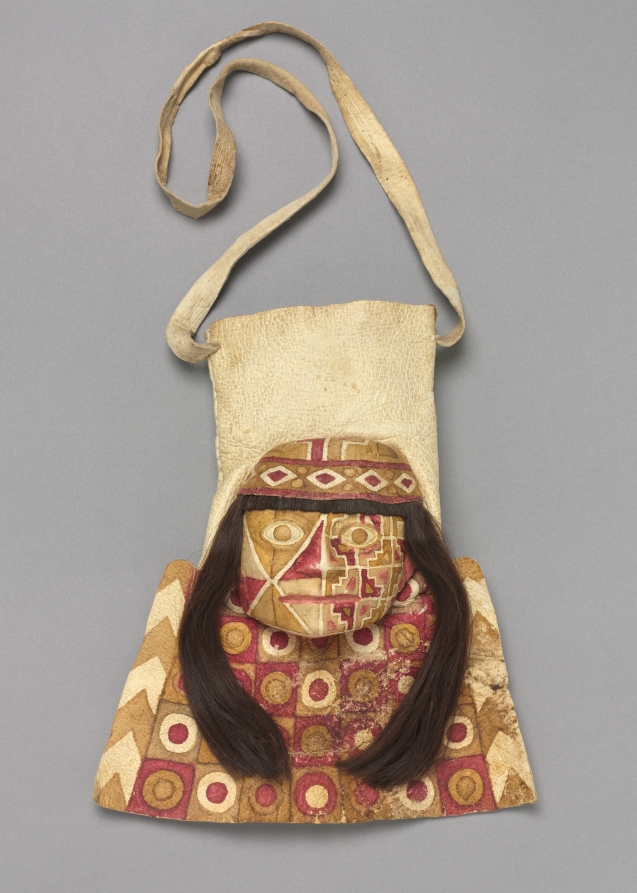
Bag with Human Face (600–1000) is in the Cleveland Museum of Art collection.
The work and its context
The museum's open-access catalogue describes the work:
The face on this bag is decorated with geometric designs that also appear on Wari warrior representations; the circles on the panel beneath the face may refer to an elite tunic made of tie-dyed cloth. The bag was used to carry coca leaves, which in the past and today have important practical and religious purposes in the Andes. Chewing the leaves during physical exertion improves stamina; when used ritually, the leaves initiate communion with cosmic forces.
Object facts
- Title: Bag with Human Face
- Date: 600–1000
- Culture: Andes, Wari, Middle Horizon, 6th-10th century
- Type: Mixed Media
- Technique: alpaca or llama hide, human hair, pigment, cotton; coca leaf contents
- Dimensions: Overall: 26.7 x 23.2 cm (10 1/2 x 9 1/8 in.); Bag: 26 cm (10 1/4 in.)
- Collection: AA - Andes
- Department: Art of the Americas
- Accession number: 2011.35
A detail from the museum
This bag was used to carry coca leaves.
Collection credit
Leonard C. Hanna Jr. Fund
Further reading listed by the museum
- Bergh, Susan E., Luis Guillermo Lumbreras, and Luis Jaime Castillo. Wari: Lords of the Ancient Andes. [New York]: Thames & Hudson; [Cleveland] : The Cleveland Museum of Art, 2012.
- Mann, C. Griffith, and Amy Bracken Sparks. "Acquisitions 2011." Cleveland Art: Cleveland Museum of Art Members Magazine 52, no. 2 (March/April 2012): 10-27.
View the collection record
See the museum's photographs and full catalogue entry. Catalogue text is reproduced from the Cleveland Museum of Art's open-access data, with HTML formatting removed. This object and its supplied image are designated CC0.
Sources
More in Lifestyle
Keep reading