Ballgame Thin Stone Head (Hacha) (600–900): Art, History and Details
Ballgame Thin Stone Head (Hacha) at the Cleveland Museum of Art: 600–900, stone. Explore the work's context, creator attribution and collection history.
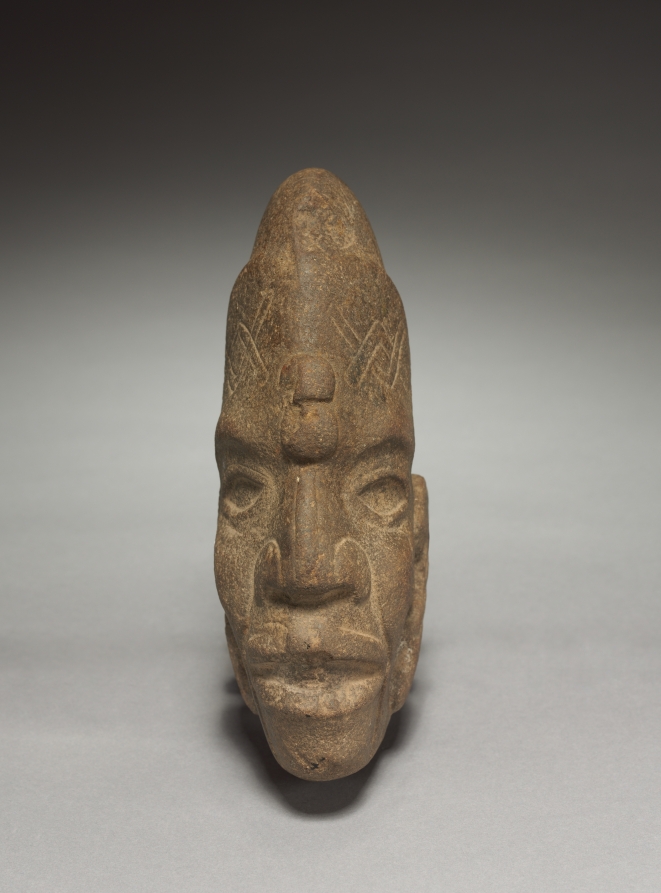
Ballgame Thin Stone Head (Hacha) (600–900) is in the Cleveland Museum of Art collection.
The work and its context
The museum's open-access catalogue describes the work:
This enigmatic head is associated with an ancient ballgame played both for sport and ceremonial purposes on Mexico’s Gulf Coast, in present-day Veracruz. It may represent an elite ballplayer or ballgame patron—the forehead is incised with interlaced designs similar to the so-called mat motif, a Maya symbol for rulership. Such heads are known as hachas (Spanish for “axe”) because they often taper to a thin edge at the front, giving them the appearance of axe heads.
Object facts
- Title: Ballgame Thin Stone Head (Hacha)
- Date: 600–900
- Culture: Mesoamerica, Classic Veracruz style
- Type: Sculpture
- Technique: stone
- Dimensions: Overall: 20 x 6.8 x 14.3 cm (7 7/8 x 2 11/16 x 5 5/8 in.)
- Collection: AA - Mesoamerica
- Department: Art of the Americas
- Accession number: 1945.33
A detail from the museum
The interlaced designs on this head’s forehead are similar to a Maya symbol for rulership.
Collection credit
Purchase from the J. H. Wade Fund
Further reading listed by the museum
- The Cleveland Museum of Art. The Cleveland Museum of Art Handbook. Cleveland, OH: The Cleveland Museum of Art, 1958.
View the collection record
See the museum's photographs and full catalogue entry. Catalogue text is reproduced from the Cleveland Museum of Art's open-access data, with HTML formatting removed. This object and its supplied image are designated CC0.
Sources
More in Lifestyle
Keep reading