Basin with Inscribed Figures and Calligraphy (1100s–1200s): Art, History and Details
Basin with Inscribed Figures and Calligraphy at the Cleveland Museum of Art: 1100s–1200s, bronze. Explore the work's context, creator attribution and collection history.
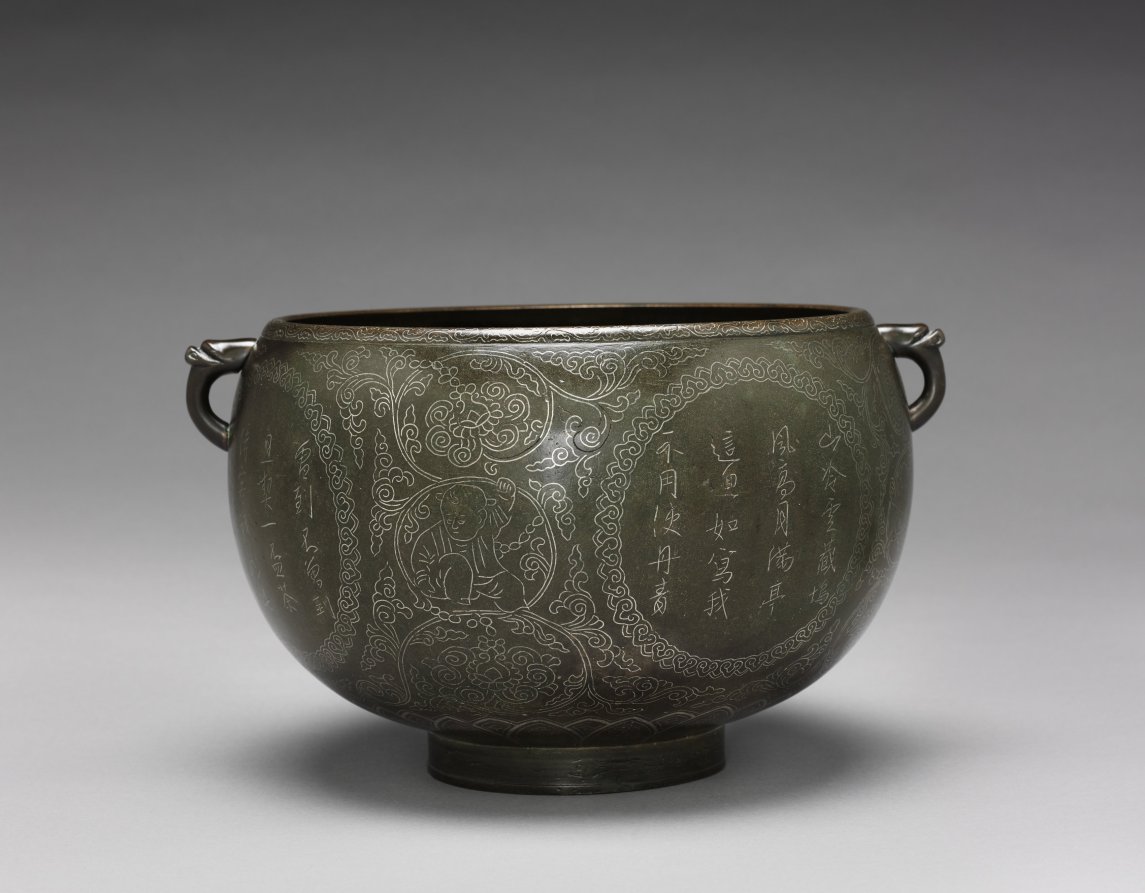
Basin with Inscribed Figures and Calligraphy (1100s–1200s) is in the Cleveland Museum of Art collection.
The work and its context
The museum's open-access catalogue describes the work:
This bronze basin may have been used for containing purified water. What makes this work charming is its intricate decoration done in silver inlay: the five-character, four-line poems interspersed among images of a child. The poems, which evoke the concept of nonattachment and nonduality, were written by Buddhist monks.
Object facts
- Title: Basin with Inscribed Figures and Calligraphy
- Date: 1100s–1200s
- Culture: Korea, Goryeo dynasty (918–1392)
- Type: Metalwork
- Technique: bronze
- Dimensions: Overall: 17 cm (6 11/16 in.); Diameter of mouth with rim: 21.7 cm (8 9/16 in.)
- Collection: Korean Art
- Department: Korean Art
- Accession number: 1985.112
A detail from the museum
A child, one of the main decorative elements for this basin, is possibly a young Buddhist pilgrim named Sudhana, who took a long spiritual journey to search for enlightenment.
Collection credit
Leonard C. Hanna Jr. Fund
Further reading listed by the museum
- Turner, Evan H. "The Year in Review for 1985." The Bulletin of the Cleveland Museum of Art 73, no. 2 (1986): 26-71.
- Cunningham, Michael R., Stanislaw J. Czuma, Anne E. Wardwell, and J. Keith Wilson. Masterworks of Asian Art. Cleveland, OH: The Cleveland Museum of Art, 1998.
- Goryeo Dynasty: Korea's Age of Enlightenment, 918-1392. San Francisco: Asian Art Museum, 2003.
View the collection record
See the museum's photographs and full catalogue entry. Catalogue text is reproduced from the Cleveland Museum of Art's open-access data, with HTML formatting removed. This object and its supplied image are designated CC0.
Sources
More in Lifestyle
Keep reading