Bath Pail (Satl) (c. 1580–1610): Art, History and Details
Bath Pail (Satl) at the Cleveland Museum of Art: c. 1580–1610, cast brass, turned, engraved, inlaid with black compound (niello). Explore the work's context, creator attribution and collection history.
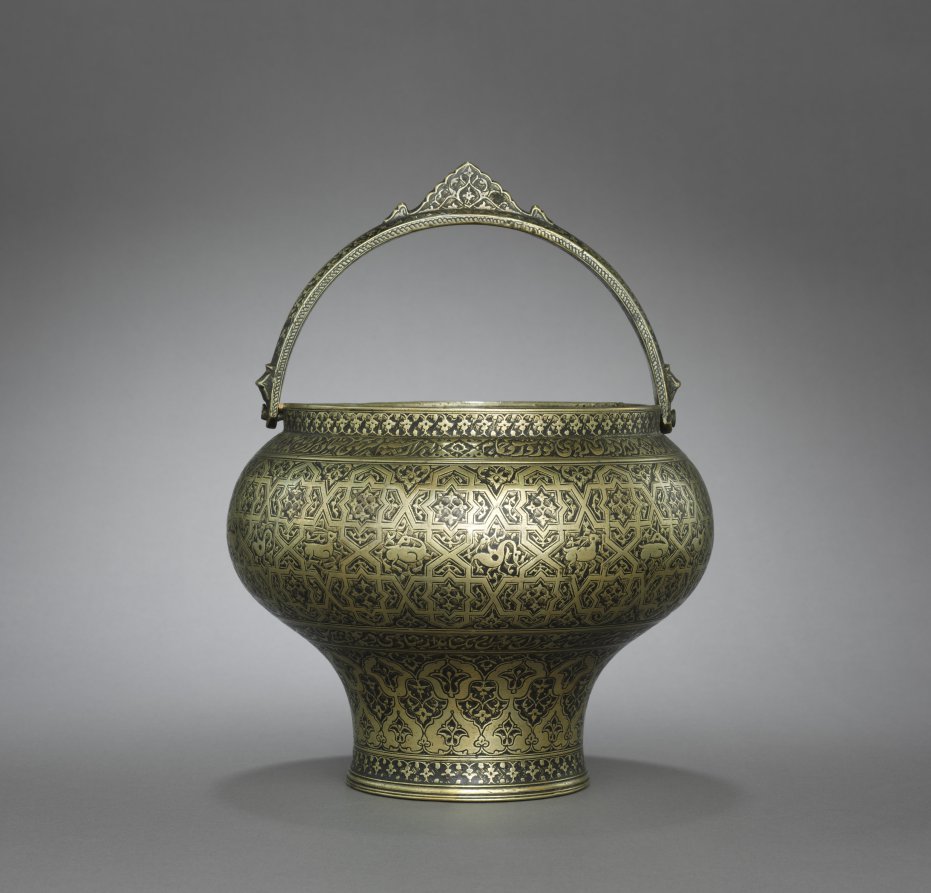
Bath Pail (Satl) (c. 1580–1610) is in the Cleveland Museum of Art collection.
The work and its context
The museum's open-access catalogue describes the work:
Building on the tradition of ancient Roman baths, the hammam (public bath) was, and still is, an integral part of social life in the Islamic world. This pail was used to carry bathing equipment for a wealthy individual from their home to the hammam. It is decorated with an interlacing geometric design with a central band of repeating animals. Bathing was a popular theme with Iranian poets. On this piece, verses by the celebrated poet Jami (died 1492) relay the story of a youth inquiring as to why the hammam brings so much joy. An elder responds, “The secret is that the bather has nothing of the trappings of this world / But a bathing-bowl and towel—and even those belong to others.”
Object facts
- Title: Bath Pail (Satl)
- Date: c. 1580–1610
- Culture: Iran, Isfahan, Safavid period (1501-1722)
- Type: Metalwork
- Technique: cast brass, turned, engraved, inlaid with black compound (niello)
- Dimensions: Overall: 17 cm (6 11/16 in.); Diameter of base: 11 cm (4 5/16 in.); Diameter of rim: 16.8 cm (6 5/8 in.)
- Collection: Islamic Art
- Department: Islamic Art
- Accession number: 1969.291
A detail from the museum
Three animal motifs are repeated within the geometric interlacing: a doe with its head turned backward; a water fowl; and a horned animal, possibly an ibex.
Collection credit
Gift of Rosenberg & Stiebel, Inc.
View the collection record
See the museum's photographs and full catalogue entry. Catalogue text is reproduced from the Cleveland Museum of Art's open-access data, with HTML formatting removed. This object and its supplied image are designated CC0.
Sources
More in Lifestyle
Keep reading