Batō (Horse-Headed) Kannon (base) (1600s–1700s): Art, History and Details
Batō (Horse-Headed) Kannon (base) at the Cleveland Museum of Art: 1600s–1700s, wood with lacquer, color, and gold. Explore the work's context, creator attribution and collection history.
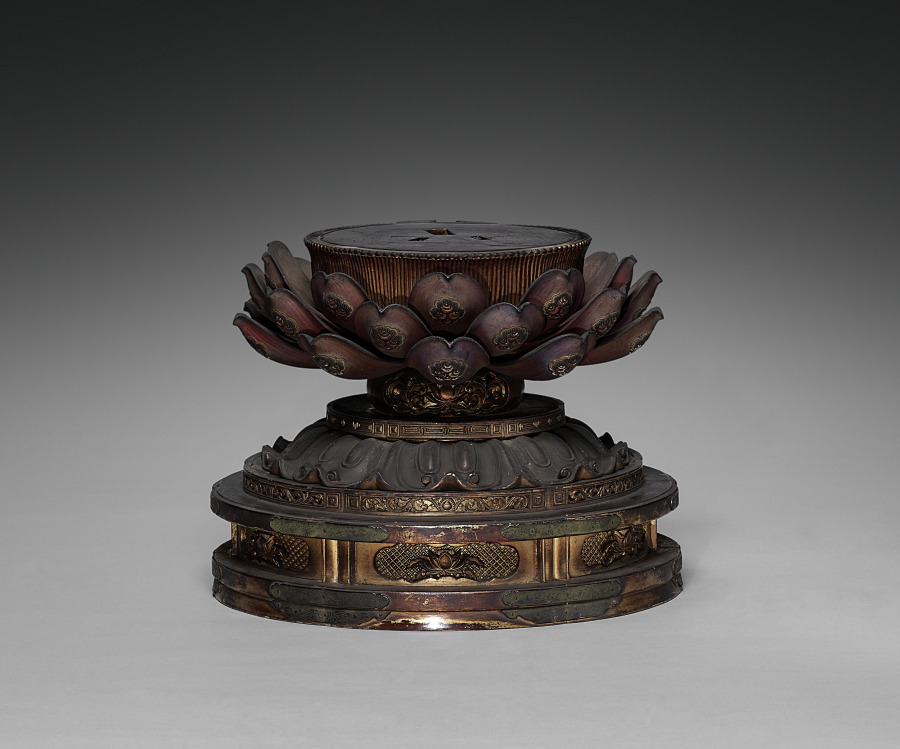
Batō (Horse-Headed) Kannon (base) (1600s–1700s) is in the Cleveland Museum of Art collection.
The work and its context
The museum's open-access catalogue describes the work:
Batō Kannon, or Hayagriva Avalokiteshvara in Sanskrit, is the “horse-headed” form of the bodhisattva of compassion, who presides over the realm of animals in the Buddhist Six Realms of Transmigration (rebirth). A horse’s head appears in the hair of this sculpture to identify it. Bodhisattvas are beings who, though enlightened, choose to remain within the worlds of existence to help others. The six realms are heaven, hell, human, animal, hungry ghost, and ashura, or fierce supernatural entities.
Object facts
- Title: Batō (Horse-Headed) Kannon (base)
- Date: 1600s–1700s
- Culture: Japan, Edo period (1615–1868)
- Type: Sculpture
- Technique: wood with lacquer, color, and gold
- Dimensions: Overall: 110.6 cm (43 9/16 in.); Base: 28 cm (11 in.); Figure: 82.6 cm (32 1/2 in.)
- Collection: Japanese Art
- Department: Japanese Art
- Accession number: 1981.1.b
Collection credit
John L. Severance Fund
Further reading listed by the museum
- Lee, Sherman E. “The Year in Review for 1981.” The Bulletin of the Cleveland Museum of Art 69, no. 2 (February 1982): 39–82.
- Grossman, Nancy, James T. Ulak, Marjorie Williams, and Laurence Channing. Art of Japan: Masterpieces from the Cleveland Museum of Art. Cleveland, OH: The Cleveland Museum of Art, 2005.
View the collection record
See the museum's photographs and full catalogue entry. Catalogue text is reproduced from the Cleveland Museum of Art's open-access data, with HTML formatting removed. This object and its supplied image are designated CC0.
Sources
More in Lifestyle
Keep reading