Beaker (c. late 600s–early 700s): Art, History and Details
Beaker at the Cleveland Museum of Art: c. late 600s–early 700s, silver with gilding. Explore the work's context, creator attribution and collection history.
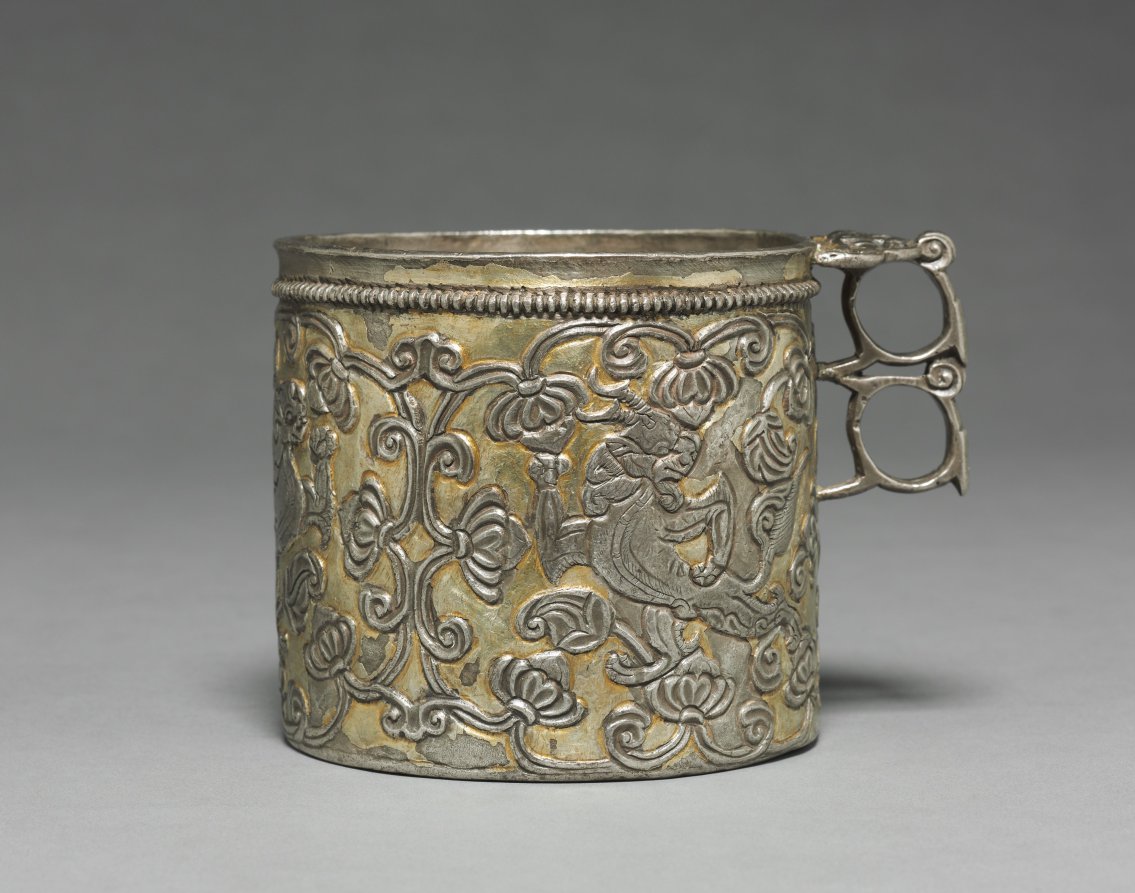
Beaker (c. late 600s–early 700s) is in the Cleveland Museum of Art collection.
The work and its context
The museum's open-access catalogue describes the work:
The circular shapes of the cup’s handle feature a flat edge on which the user rested their thumb for better grip, a design characteristic of silver objects made during the 700s by Sogdian artists, who traveled from Central Asia along international trade routes. An ownership inscription in Tibetan script on the underside of the cup identifies the vessel as a personal possession. The circles and lines carved below this inscription are likely measurements recording the weight of the silver used for the cup.
Object facts
- Title: Beaker
- Date: c. late 600s–early 700s
- Culture: Central Asia (Sogdiana) or Tibet
- Type: Silver
- Technique: silver with gilding
- Dimensions: Diameter: 10.2 cm (4 in.); Overall: 10.2 cm (4 in.);
- Collection: Tibetan Art
- Department: Indian and Southeast Asian Art
- Accession number: 1988.67.2
A detail from the museum
This cup depicts two lions and a lionlike animal with horns!
Collection credit
The Severance and Greta Millikin Purchase Fund
Further reading listed by the museum
- “The Year in Review for 1988.” The Bulletin of the Cleveland Museum of Art 76, no. 2 (February 1989): 30–75.
- Czuma, Stan. "Museum Acquisitions and Notes." Bulletin of the Asia Institute vol. 5 (1991), 190.
- “Recent Acquisitions at the Cleveland Museum of Art II: Departments of Asian Art: Supplement.” The Burlington Magazine 133, no. 1059 (June 1991): 417–424.
View the collection record
See the museum's photographs and full catalogue entry. Catalogue text is reproduced from the Cleveland Museum of Art's open-access data, with HTML formatting removed. This object and its supplied image are designated CC0.
Sources
More in Lifestyle
Keep reading