Beauty with Fireflies (early 1800s): Art, History and Details
Beauty with Fireflies at the Cleveland Museum of Art: early 1800s, Hanging scroll; ink and color on silk (ivory roller ends). Explore the work's context, creator attribution and collection history.
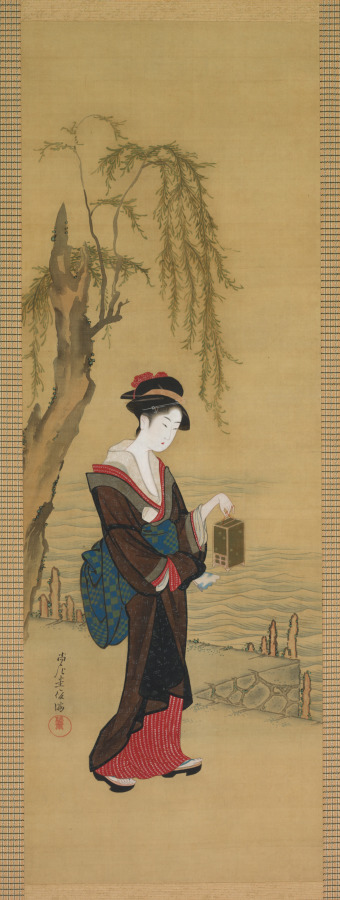
Beauty with Fireflies (early 1800s) is in the Cleveland Museum of Art collection. The museum's creator attribution is Kubo Shunman (Japanese, 1757–1820).
The work and its context
The museum's open-access catalogue describes the work:
A young woman has passed beneath an aged willow tree as she strolls along a riverbank carrying a cage full of fireflies. The painting is a copy after Kubo Shunman, best known as a composer of witty verses in 31-syllables (kyōka) and designer of limited edition prints called surimono. Shunman was active during the mature era of ukiyo-e production, and his more formal paintings most often took as their subjects beautiful Chinese or Japanese women. Here, his imitator commemorates one of summer's most delightful evening pastimes, the observation of the flickering lights of the firefly. The woman is presented in a ubiquitous summer setting, a refreshingly cool and breezy riverbank in earshot of rustling willow leaves.
Object facts
- Title: Beauty with Fireflies
- Date: early 1800s
- Creator attribution: Kubo Shunman (Japanese, 1757–1820)
- Culture: Japan, Edo period (1615–1868)
- Type: Painting
- Technique: Hanging scroll; ink and color on silk (ivory roller ends)
- Dimensions: Mounted: 181.5 x 45.6 cm (71 7/16 x 17 15/16 in.); Painting: 95.6 x 33.2 cm (37 5/8 x 13 1/16 in.)
- Collection: ASIAN - Hanging scroll
- Department: Japanese Art
- Accession number: 2015.85
Collection credit
Gift of the Kelvin Smith Family
View the collection record
See the museum's photographs and full catalogue entry. Catalogue text is reproduced from the Cleveland Museum of Art's open-access data, with HTML formatting removed. This object and its supplied image are designated CC0.
Sources
More in Lifestyle
Keep reading