Bidri Basin (c. 1650): Art, History and Details
Bidri Basin at the Cleveland Museum of Art: c. 1650, Zinc alloy with silver and brass inlay. Explore the work's context, creator attribution and collection history.
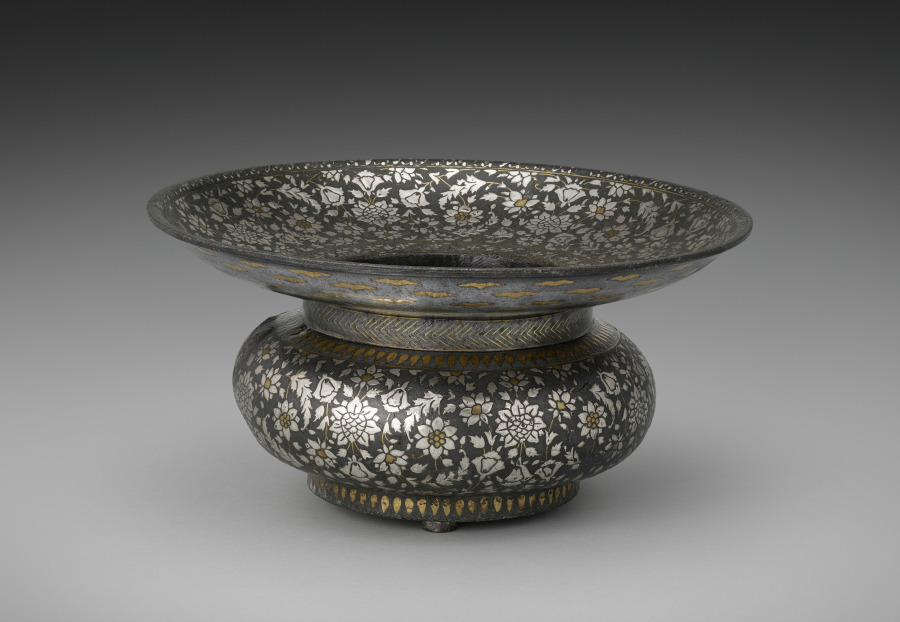
Bidri Basin (c. 1650) is in the Cleveland Museum of Art collection.
The work and its context
The museum's open-access catalogue describes the work:
Wide-rimmed basins called sailabchi were used to catch water poured from a pitcher during hand washing before prayer and before and after meals. A sumptuous example such as this was made for an elite setting. Every element of the allover floral arabesque was cut from silver and brass sheets or wire and hammered into the cast zinc alloy vessel in a distinctive technique developed in southern India.
Object facts
- Title: Bidri Basin
- Date: c. 1650
- Culture: Southwestern India, Deccan, Karnataka, Bidar
- Type: Metalwork
- Technique: Zinc alloy with silver and brass inlay
- Dimensions: Diameter: 34.5 cm (13 9/16 in.); height: 17 cm (6 11/16 in.)
- Collection: Indian Art
- Department: Indian and Southeast Asian Art
- Accession number: 2020.205
A detail from the museum
Zinc alloy does not rust or corrode, in contrast to steel or copper alloys.
Collection credit
Severance and Greta Millikin Purchase Fund
Further reading listed by the museum
- Gray, Basil, editor. The Arts of India. Oxford: Phaidon, 1981.
- Zebrowski, Mark. "Bidri: Metalware from the Islamic Courts of India," in Art East. London, England: Hali Publications, 1982.
- Zebrowski, Mark. Gold, Silver & Bronze from Mughal India. London: Alexandria Press in association with Laurence King, 1997.
View the collection record
See the museum's photographs and full catalogue entry. Catalogue text is reproduced from the Cleveland Museum of Art's open-access data, with HTML formatting removed. This object and its supplied image are designated CC0.
Sources
More in Lifestyle
Keep reading