Bifolium Excised from a Carolingian Gradual (verso) (c. 830–860): Art, History and Details
Bifolium Excised from a Carolingian Gradual (verso) at the Cleveland Museum of Art: c. 830–860, gold and silver ink on purple parchment. Explore the work's context, creator attribution and collection history.
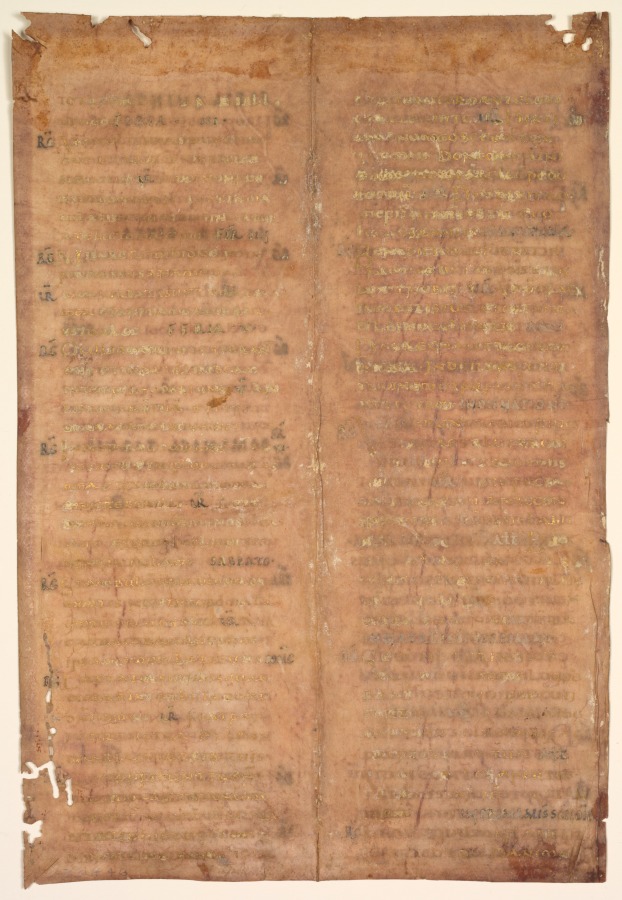
Bifolium Excised from a Carolingian Gradual (verso) (c. 830–860) is in the Cleveland Museum of Art collection.
The work and its context
The museum's open-access catalogue describes the work:
This rare leaf comes from a cantatorium or gradual, a book containing the chants to be sung during the Mass. Other leaves from the same book survive in Berlin and Trier. A bifolium, or double-leaf, it does not contain decorated letters but rather "emphasized" letters. These were enlarged and pushed out into the margins to call attention to the eye. Such emphasized letters originated in late classical times and were the precursor to the decorated initial developed by medieval scribes. The purple-stained vellum (now faded to a deep pink) with its text written in gold and silver inks (now turned black) suggested great luxury with its sumptuous appearance. In Mediterranean regions, the purple dye was obtained from murex, a shell-fish dye. In northern Europe, plant dyes were used as an alternative. Combined with the use of gold and silver ink (now turned black) a spectacular appearance was achieved that is traceable back to classical antiquity.
Object facts
- Title: Bifolium Excised from a Carolingian Gradual (verso)
- Date: c. 830–860
- Culture: Germany or Northeastern France, 9th century
- Type: Manuscript
- Technique: gold and silver ink on purple parchment
- Dimensions: Sheet: 29 x 10 cm (11 7/16 x 3 15/16 in.); Framed: 39.4 x 52.1 x 3.2 cm (15 1/2 x 20 1/2 x 1 1/4 in.)
- Collection: MED - Manuscript Illuminations
- Department: Medieval Art
- Accession number: 1933.446.b
Collection credit
Purchase from the J. H. Wade Fund
View the collection record
See the museum's photographs and full catalogue entry. Catalogue text is reproduced from the Cleveland Museum of Art's open-access data, with HTML formatting removed. This object and its supplied image are designated CC0.
Sources
More in Lifestyle
Keep reading