Birds and Flowers (late 1500s): Art, History and Details
Birds and Flowers at the Cleveland Museum of Art: late 1500s, One of a pair of six-panel folding screens; ink, color, and gold on paper. Explore the work's context, creator attribution and collection history.
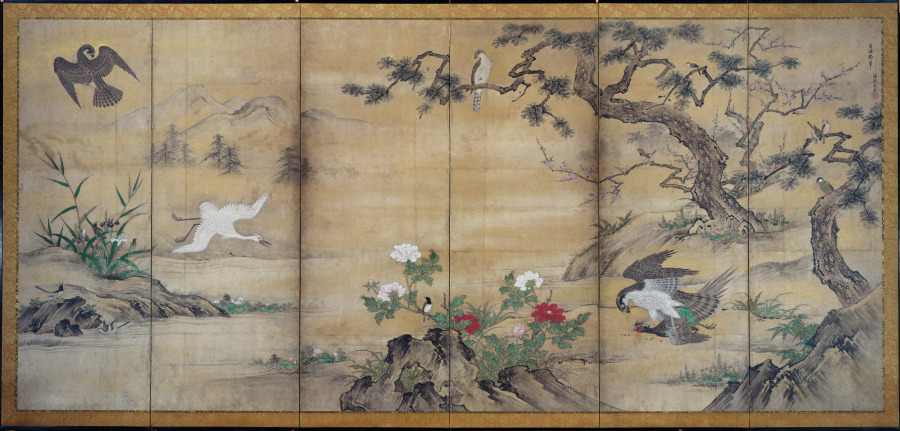
Birds and Flowers (late 1500s) is in the Cleveland Museum of Art collection. The museum's creator attribution is Kano Shōei (Japanese, 1519–1592).
The work and its context
The museum's open-access catalogue describes the work:
The landscape depicted in this pair of screens follows a seasonal progression from right to left, starting with the blossoming plum of early spring and ending with late autumn peonies. A variety of smaller birds are positioned throughout the scene, and a trio of swimming ducks is bracketed by early summer irises and early autumn bellflowers at the center. While some raptors (birds of prey) terrorize a pheasant and an egret (a waterfowl) to the right, a peacock and peahen converse to the left. Hawks are associated with military prowess, while the peafowl suggest cultural prestige.
Object facts
- Title: Birds and Flowers
- Date: late 1500s
- Creator attribution: Kano Shōei (Japanese, 1519–1592)
- Culture: Japan, Momoyama period (1573–1615)
- Type: Painting
- Technique: One of a pair of six-panel folding screens; ink, color, and gold on paper
- Dimensions: Image: 155.9 x 339.4 cm (61 3/8 x 133 5/8 in.); Overall: 168.5 x 352.2 cm (66 5/16 x 138 11/16 in.); Closed: 172.5 x 61 x 11.3 cm (67 15/16 x 24 x 4 7/16 in.); with frame: 171.7 x 355.4 cm (67 5/8 x 139 15/16 in.)
- Collection: ASIAN - Folding screen
- Department: Japanese Art
- Accession number: 1948.128.1
A detail from the museum
Military class patrons frequently requested scenes depicting predation, such as hunting scenes that were inserted as additional subject matter in otherwise tranquil vistas celebrating flora and fauna.
Collection credit
Gift of William G. Mather
Further reading listed by the museum
- Chiba-shi Bijutsukan. Shugyoku no Nihon bijutsu: Hosomi korekushon no zenbō to Bosuton, Kurīburando, Sakkurā no wadaisaku: kaikan isshūnen kinen. Chiba-shi: Chiba-shi Bijutsukan, 1996.
- Tōyō kaiga no seika: tokubetsuten: Kurīvurando Bijutsukan no korekushon kara [東洋絵画の精華: 特别展: クリーヴラント美術館のコレクションから= Highlights of Asian painting from the Cleveland Museum of Art]. Nara, Japan: Nara National Museum, 1998.
- Cunningham, Michael R. "Discovering Japanese Screens." Cleveland Art: Cleveland Museum of Art Members Magazine 41, no. 6 (Summer 2001): 4–5.
View the collection record
See the museum's photographs and full catalogue entry. Catalogue text is reproduced from the Cleveland Museum of Art's open-access data, with HTML formatting removed. This object and its supplied image are designated CC0.
Sources
More in Lifestyle
Keep reading