Black-Figure Amphora (Type B; Storage Vessel): Battling Warriors (A); Dionysos and Satyrs (B) (c. 530–520 BCE): Art, History and Details
Black-Figure Amphora (Type B; Storage Vessel): Battling Warriors (A); Dionysos and Satyrs (B) at the Cleveland Museum of Art: c. 530–520 BCE, ceramic. Explore the work's context, creator attribution and collection history.
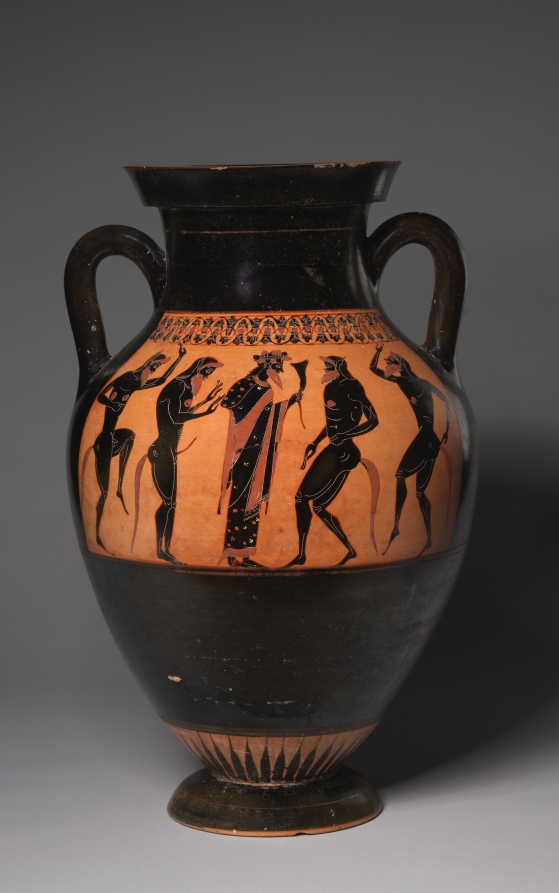
Black-Figure Amphora (Type B; Storage Vessel): Battling Warriors (A); Dionysos and Satyrs (B) (c. 530–520 BCE) is in the Cleveland Museum of Art collection. The museum's creator attribution is The Bateman Group; Lysippides Painter (Greek, Attic, active c. 530–515 BCE).
The work and its context
The museum's open-access catalogue describes the work:
Formerly owned by John Bateman, Esq., this amphora provided a name for the Bateman Group, five amphorae likely decorated by a single painter. On either side, a reserved panel holds a carefully composed scene: four striding soldiers above a fallen warrior; and four dancing satyrs around the wine god Dionysos. Similar scenes appear on other Bateman Group vases, as well as in the much larger body of work attributed to the more well-known Lysippides Painter.
Object facts
- Title: Black-Figure Amphora (Type B; Storage Vessel): Battling Warriors (A); Dionysos and Satyrs (B)
- Date: c. 530–520 BCE
- Creator attribution: The Bateman Group; Lysippides Painter (Greek, Attic, active c. 530–515 BCE)
- Culture: Greek, Attic
- Type: Ceramic
- Technique: ceramic
- Dimensions: Overall: 49.5 cm (19 1/2 in.)
- Collection: GR - Greek
- Department: Greek and Roman Art
- Accession number: 1927.433
A detail from the museum
This vase was already old-fashioned when first made; its shape was preferred by earlier generations of vase painters.
Collection credit
The A. W. Ellenberger, Sr., Endowment Fund
Further reading listed by the museum
- Beazley Archive. n.d. Beazley Archive Pottery Database. Oxford: Beazley Archive.
- Sotheby & Co. (London, England). Palaeolithic Implements, Egyptian, Greek, Cypriot and Roman Antiquities. London: Sotheby, 1926.
- Howard, R. “Orestes Sarcophagus and Greek Accessions.” The Bulletin of the Cleveland Museum of Art 15, no. 4 (1928): pp. 85-86, 90-91.
View the collection record
See the museum's photographs and full catalogue entry. Catalogue text is reproduced from the Cleveland Museum of Art's open-access data, with HTML formatting removed. This object and its supplied image are designated CC0.
Sources
More in Lifestyle
Keep reading